The Great Pyramid of Giza: hidden chambers, extreme precision and what modern scanners found
Particles arriving from space revealed two unknown empty spaces inside a monument that archaeologists have studied for more than 150 years.
- When
- c. 2560 BC
- Where
- Giza, Egypt
- Status
- Partly explained the main explanation is accepted; details remain open
By The Echoes of the Past team. Published November 2, 2026. 6 min read.
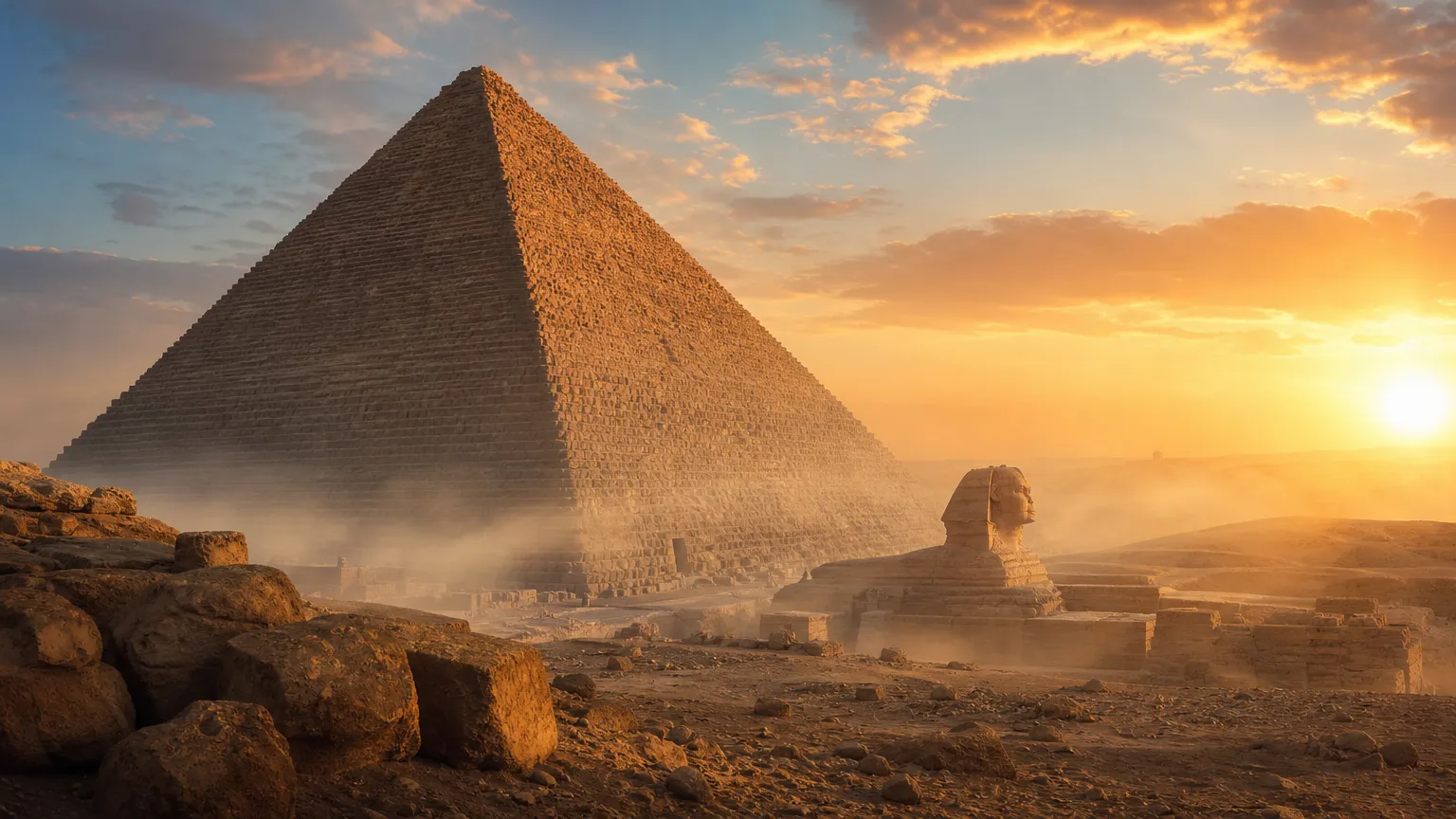
The Great Pyramid of Giza is the only one of the Seven Wonders of the Ancient World that still exists. It was the tallest structure on the planet for 3,800 years, surpassed only in AD 1311 by Lincoln Cathedral, in England. It is made of roughly 2.3 million blocks of limestone and granite, averaging 2.5 tonnes each, and some blocks in the King's Chamber reach 80 tonnes.
And in 2017, scanners using subatomic particles revealed a previously unknown cavity inside it, large enough to hold a mid-sized airplane.
What is in there, we still do not know.
The numbers that keep surprising
The precision of the Great Pyramid is documented and verifiable, and it remains one of its most unsettling features.
Its alignment with the cardinal points is extraordinary: the four sides of the pyramid face north, south, east and west with an average deviation of just 3 minutes and 6 seconds of arc from true north (geographic, not magnetic). To achieve that precision, the builders needed a way of finding north that did not rely on a compass (which did not exist) and was more accurate than any simple visual method. The most widely accepted hypothesis involves observing circumpolar stars, stars that never set below the horizon and trace a circle around the celestial pole, but the exact method is still debated.
The leveling of the base shows a maximum deviation of 2.1 centimeters across a base 230 meters on each side. In a stone structure in the desert, without laser technology, that degree of leveling requires sophisticated methods. The most widely accepted hypothesis involves water channels used as a leveling system, since the surface of water is perfectly flat by nature.
Some point to the golden ratio in several ratios between the pyramid's dimensions, although archaeologists debate whether this is deliberate or the natural result of certain aesthetic proportions the Egyptians used independently of the formal mathematical concept.
Who built it and how: what archaeology has established
A persistent myth holds that the pyramid was built by slaves. The archaeological record tells a different story.
The workers' villages excavated in the 1990s by archaeologist Mark Lehner revealed that the builders were paid laborers, with a high-quality diet (records of beef, goat meat and beer consumed in quantity), medical care documented in the bones that were found (with evidence of surgery and recovery) and organized work hierarchies. Inscriptions on the stones, graffiti left by work gangs who identified their group with names such as "Friends of Khufu," confirm an organized workforce, and possibly one proud of what it did.
Current estimates of the total workforce range from 20,000 to 30,000 people at the peak of construction, which lasted about 20 years: the reign of the pharaoh Khufu (Cheops), around 2560 BC.
Moving the blocks involved ramps of sand and moistened clay: it was found that wet sand reduces friction enough for teams of workers to drag large blocks on wooden sledges. An Egyptian wall painting from 1880 BC shows exactly this process, with a worker pouring liquid in front of the sledge.
What the scanners discovered
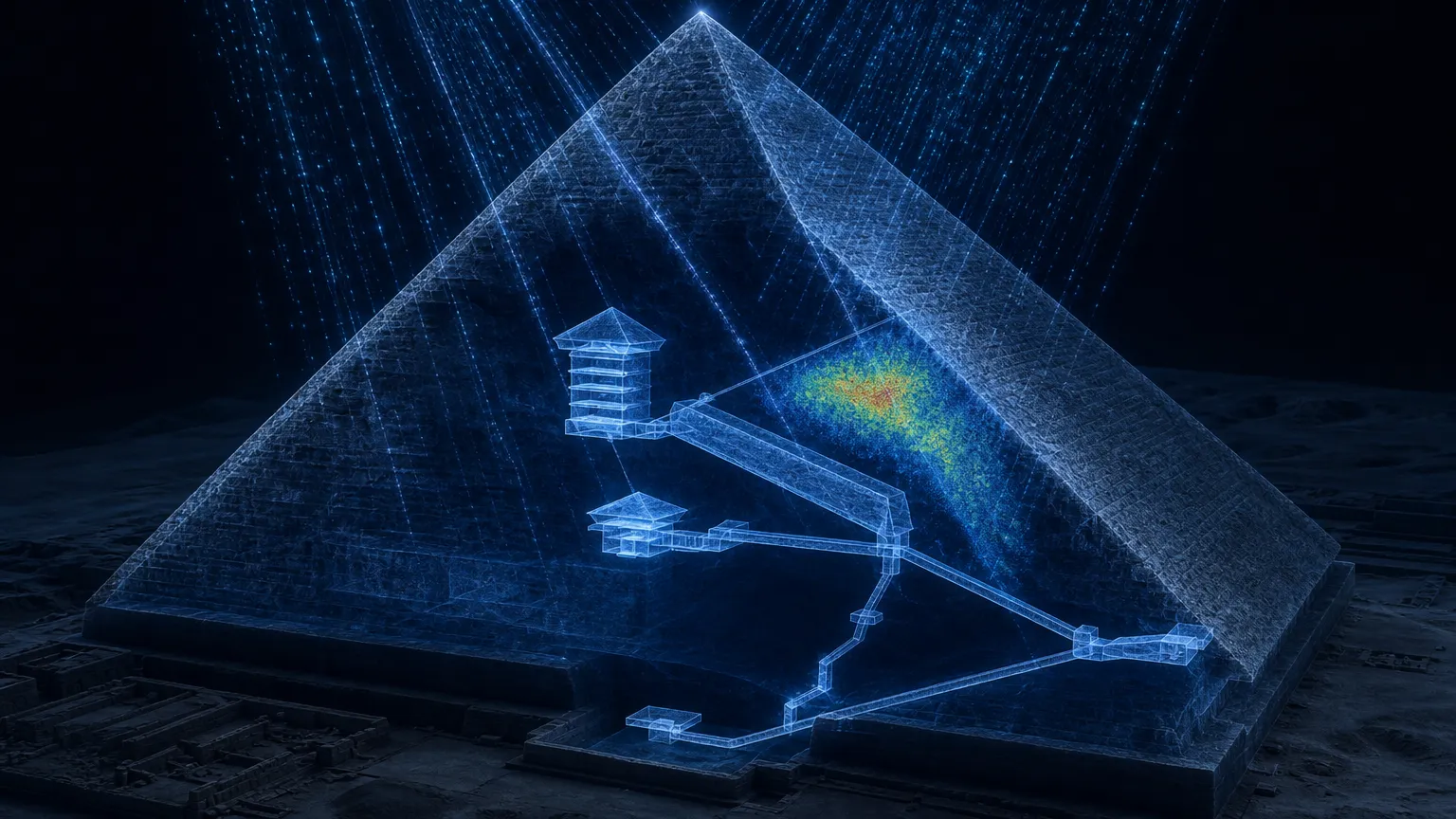
In 2015, the ScanPyramids project, a collaboration among universities in Japan, France and Egypt, began the first systematic scan of the interior of the Great Pyramid using non-invasive technologies: infrared thermography, radar and, above all, muon tomography.
Muons are subatomic particles produced when cosmic rays interact with the atmosphere. They pass through solid materials such as stone, but are absorbed in different amounts depending on the density of the material they cross. Detectors placed inside the pyramid can map variations in density, and therefore detect empty chambers, without digging anything.
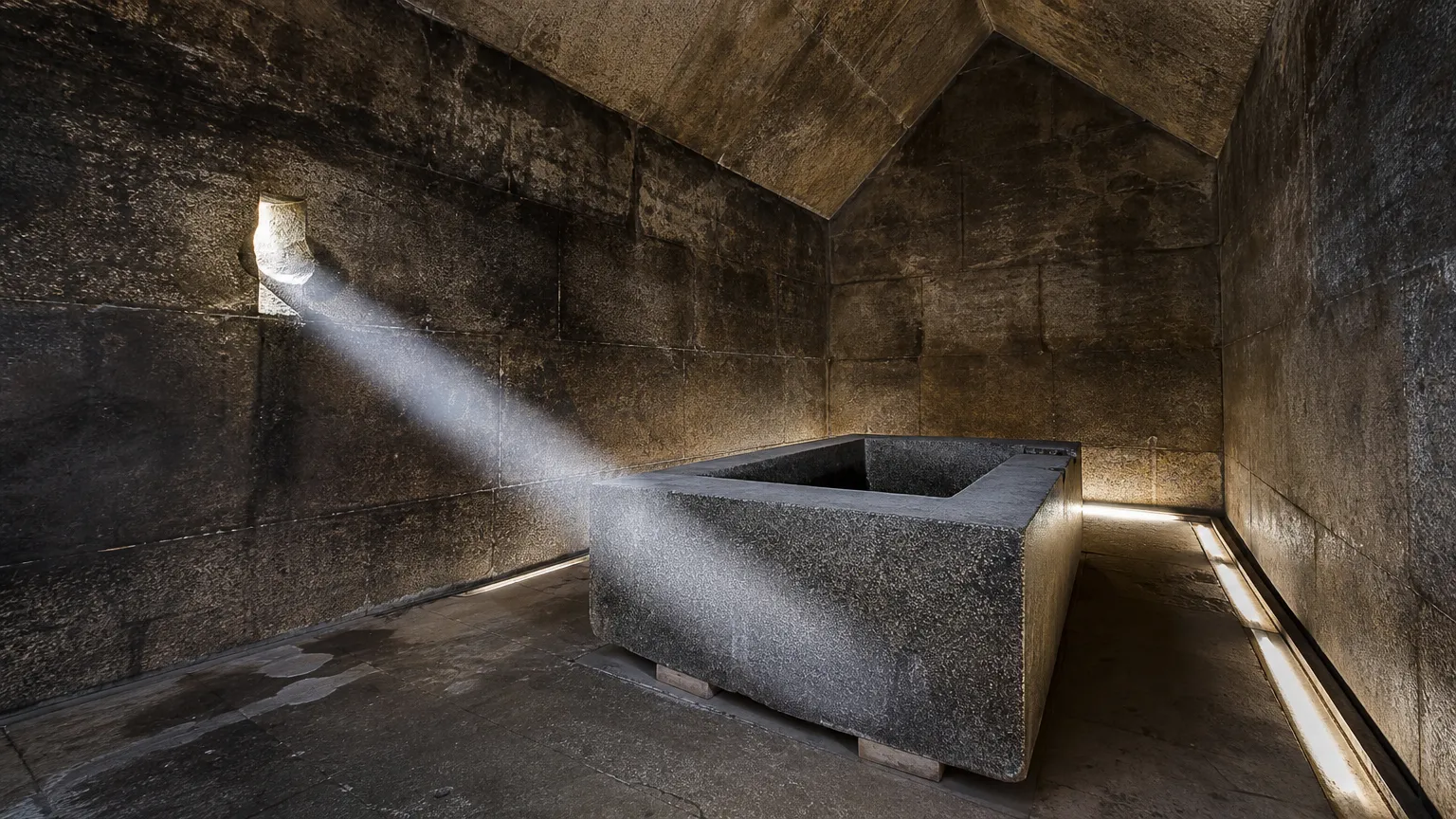
In 2017, the ScanPyramids team announced the discovery of a large cavity above the Grand Gallery, the sloping corridor that leads to the King's Chamber. The cavity, described in the journal Nature, is at least 30 meters long and has a cross-section similar to that of the Grand Gallery.
No one knows what is there. No one knows whether it is a deliberately built chamber, a structural pressure-relief space (like the known relieving chambers above the King's Chamber) or something else entirely.
In 2023, a new study published in Nature Communications identified a narrow corridor behind the pyramid's north face, above the main entrance, roughly 9 meters long. An endoscopic camera inserted through a crack revealed an empty space with limestone walls. What lies at the end of that corridor (another chamber, a passage or simply a structural void) remains unknown.
The questions that remain
On construction: the general mechanics of construction are understood. What is not fully resolved is how the granite blocks of the King's Chamber, weighing between 25 and 80 tonnes and brought from Aswan, 900 kilometers away, were hoisted to a height of 43 meters and set in place with the precision they show. The hypothesis of an internal spiral ramp is one of the most discussed, but no complete reconstruction has been demonstrated.
On the discovered chambers: how many chambers inside the pyramid have yet to be identified? What does the large cavity detected in 2017 contain? What is the purpose of the corridor found in 2023?
On orientation: how did the builders find north with the documented precision?
On the date: the conventional dating of the pyramid (around 2560 BC, based on historical records of Khufu's reign) is accepted by most archaeologists. Some authors, mostly from outside academic archaeology, dispute that date, arguing that certain astronomical alignments correspond to different periods. Most of the archaeological community considers the conventional dating solid.
What comes next
The ScanPyramids project is ongoing. New generations of muon detectors, more sensitive than those used in 2017, are being developed for field use. Egypt's antiquities authority has approved further non-invasive exploration.
The prospect that the pyramid, systematically studied by archaeologists for more than 150 years, may still hold untouched chambers is one of the most exciting possibilities in archaeology today. If the chambers exist and contain archaeological material (texts, objects, mummies), it would have remained sealed for 4,500 years.
Nan Madol, in Micronesia, holds a similar mystery: a city built with 250,000 tonnes of basalt in the middle of the Pacific, with less than 5% of its system of underground caves explored.
What could be inside the pyramid? Archives from Khufu's reign? Religious texts that have not survived in any other form? Or structurally necessary, empty chambers that the scans flagged as potentially significant but that will turn out to hold nothing but stone?
The answer lies a few meters inside the most famous stone in the world. And we still have no way of getting there without destroying what we are trying to find.
The Great Pyramid connects to other enigmas of monumental construction. For stones moved without a complete explanation on other continents, read about Sacsayhuamán and about Göbekli Tepe, the oldest temple in the world, raised by hunters without agriculture. For a hidden chamber of an entirely different kind, see Derinkuyu, Turkey's underground city.