Derinkuyu: the 18-level underground city hidden beneath an ordinary house
Beneath an ordinary house in Cappadocia lay tunnels, churches, stables and wells for thousands of people. And no one yet knows how much remains to be mapped.
- When
- c. 800 BC to the 10th century AD
- Where
- Derinkuyu, Cappadocia, Turkey
- Status
- Partly explained the main explanation is accepted; details remain open
By The Echoes of the Past team. Published November 2, 2026. 3 min read.
In 1963, a resident of the town of Derinkuyu, in the Cappadocia region, was renovating his house when he knocked down a wall. Behind it was a dark passage. The passage led to another passage. Which led to a room. Which led to a staircase. Which went down.
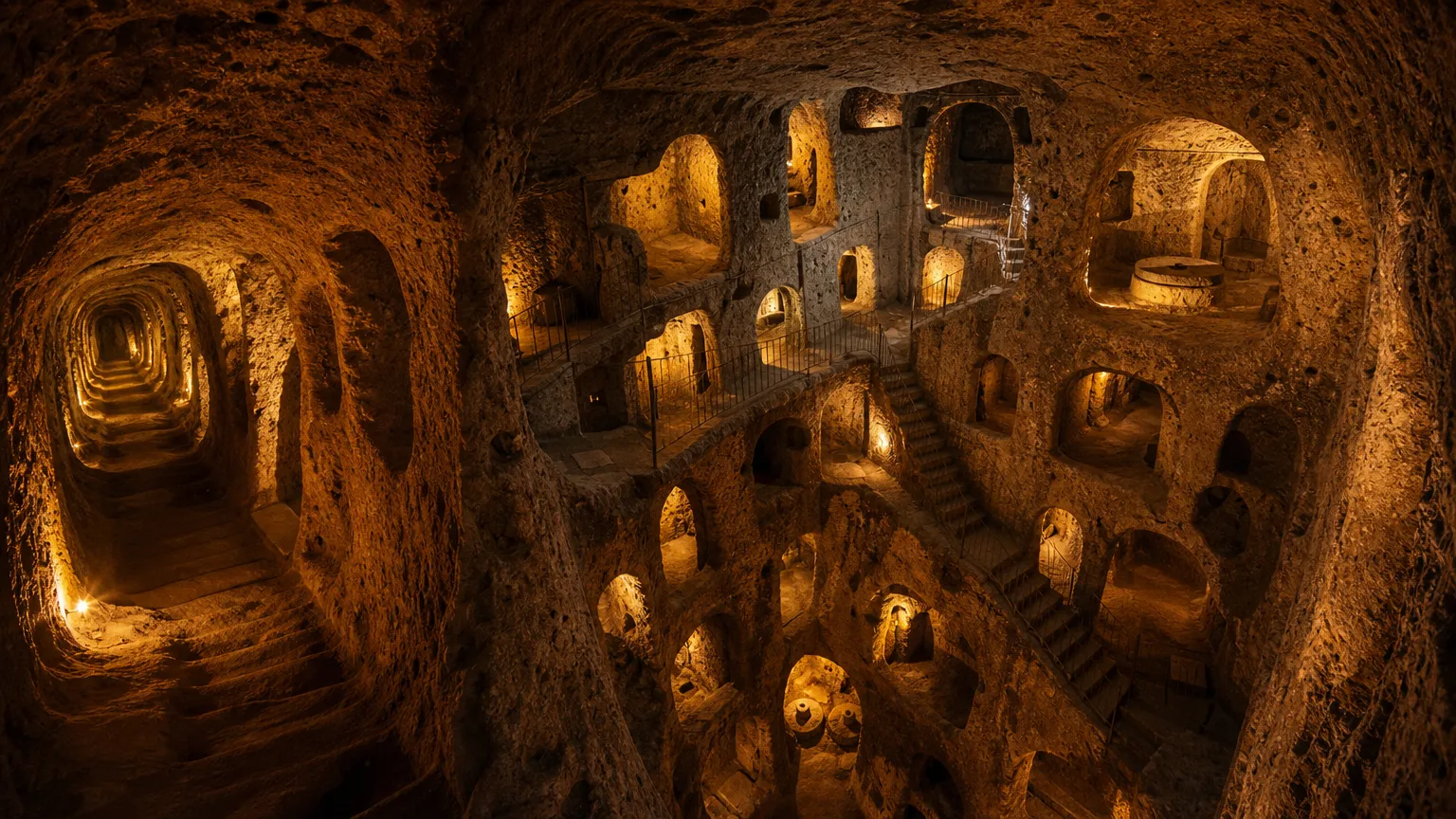
He kept going down. There were more rooms, more passages, more stairs. Ventilation, cisterns, stables, kitchens, churches, food stores, wells.
Beneath his house lay an entire city: 18 underground levels, 85 meters deep, with an estimated capacity of 20,000 people. And it was not the only one in the region.
What lies below
Derinkuyu descends roughly 85 meters below the surface across 18 functional levels.
The upper levels housed stables for animals, with tethering rings still visible. The middle levels held dwellings, food and wine stores, kitchens with ventilation openings, and water wells. The deepest levels included a school with stone benches, a cruciform church and, on the lowest floor, a tunnel several kilometers long that links Derinkuyu to another underground city, Kaymakli.
The ventilation system is extraordinary: more than 50 vertical shafts keep the air constantly renewed on all 18 levels. Without them, 20,000 people would make the air unbreathable within hours. In ambition, the engineering rivals that of the Great Pyramid of Giza, where chambers recently detected by muon scanners show that the Egyptians also built in depth with unsettling precision.
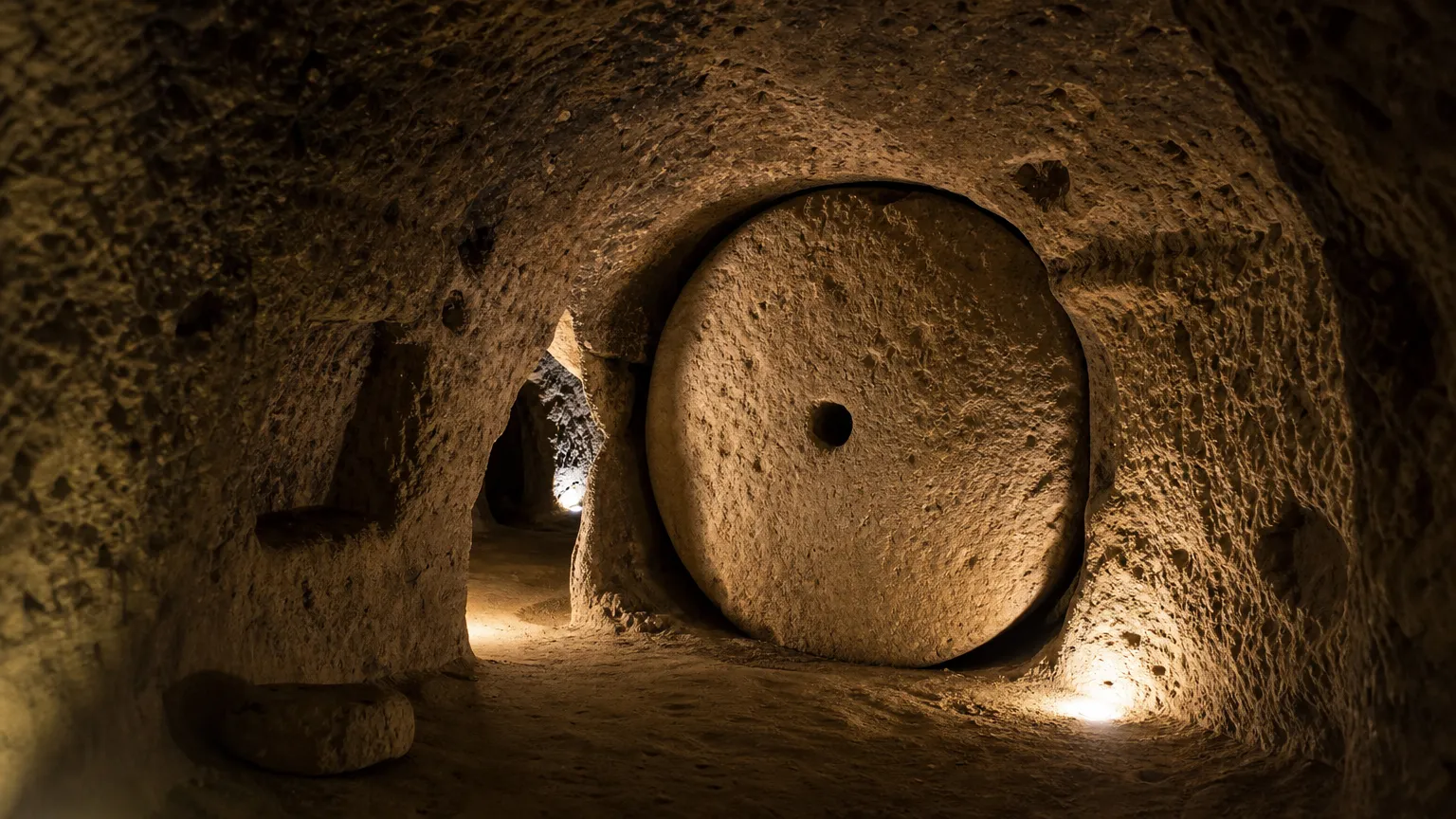
The doors: circular stones weighing 200 to 500 kilograms that rolled along tracks carved into the rock to seal the entrances. They could only be moved from the inside, and a central hole let defenders thrust spears through without opening the door. It is a security system designed with cold, efficient engineering.
Who built it, and why
Derinkuyu was probably built and expanded by several civilizations over millennia. Cappadocia's rock is volcanic tuff: easy to dig with simple tools, but it hardens when exposed to air, which keeps the tunnels stable. An ideal material for building underground.
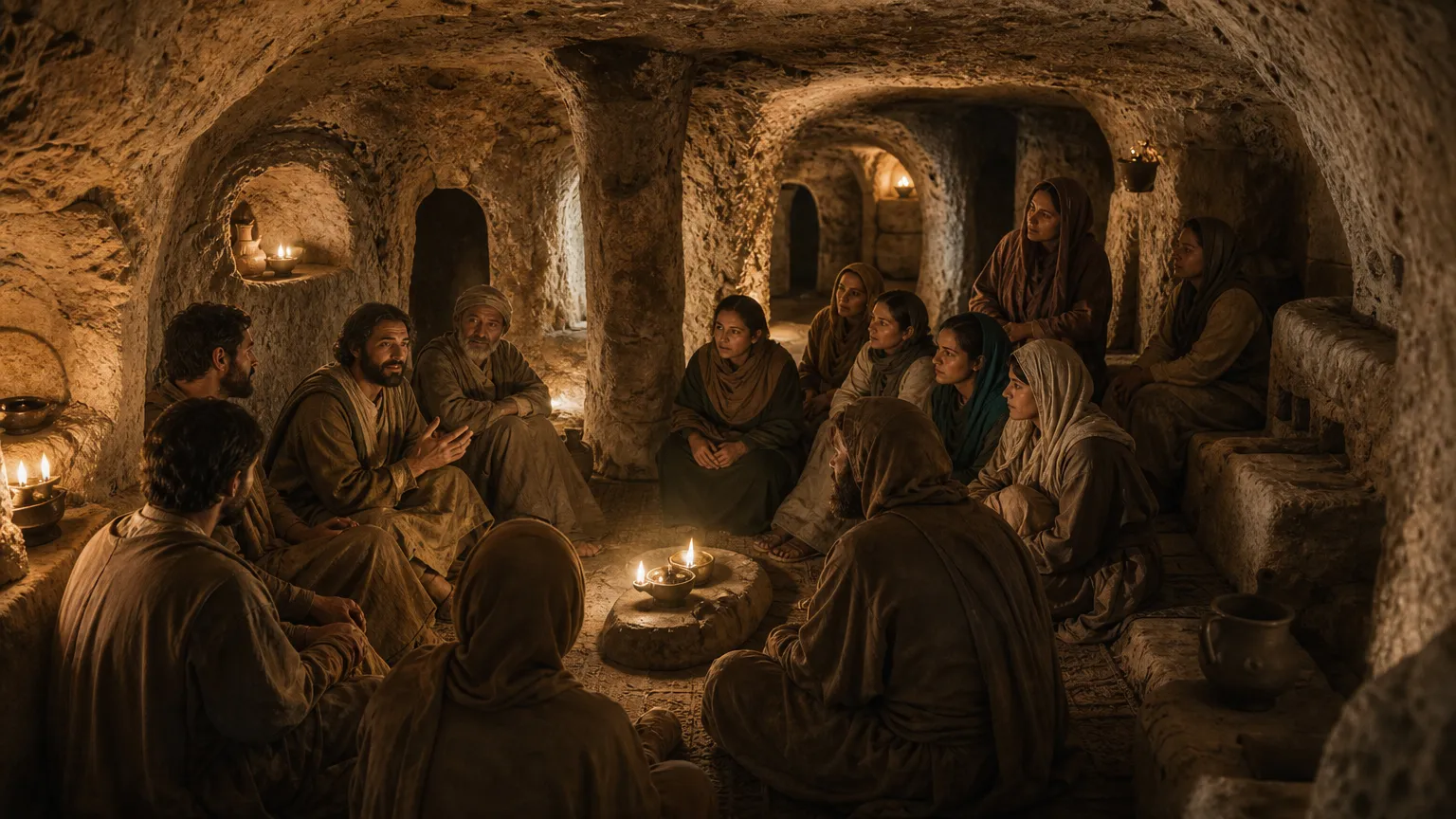
The earliest origins are attributed, without consensus, to the Hittites (around 1800 BC), with expansions by the Phrygians (800 BC) and, above all, by the Christians of Cappadocia between the 7th and 10th centuries AD, when Arab raids made an underground refuge a frequent necessity.
The temperature inside is constant: 13 to 15 °C all year round, whatever the weather above. In Cappadocia's harsh winter, that is an enormous advantage. But the psychological cost of weeks underground, without natural light, in cramped spaces, with 20,000 people (and their animals) is considerable.
What kind of threat made this preferable to the surface? The chroniclers who described the Arab invasions give the answer: threats that destroyed villages, enslaved survivors and burned everything.
What is still being discovered
In 2013, the demolition of houses for an urban renewal project in Nevşehir exposed the entrance to another underground complex, potentially larger than Derinkuyu. Preliminary excavations are promising, but they are still underway.
Cappadocia has more than 200 identified underground structures. Modern ground-penetrating radar keeps revealing new cavities, following the same logic of noninvasive scanning that, using muons, found an unknown chamber inside the Great Pyramid of Giza in 2017. And, like the sunken city of Dwarka, Derinkuyu remains partly unexplored. How many kilometers of tunnels lie beneath the region, no one has mapped yet.
Derinkuyu is the largest we know of. It may not be the largest that exists.
For other places where fear shaped the architecture, read about Nan Madol, where an entire people lived on the ocean, and about Sacsayhuamán, designed to withstand invasions and earthquakes. For another case in which people hastily abandoned their own shelter, see the Dyatlov Pass incident.