The Count of Saint-Germain: the man who seemed centuries old and never denied it
He spoke many languages, mastered chemistry and told stories from centuries past as if he had lived them. To this day, no one knows for sure who he was.
- When
- 1740s–1784
- Where
- Versailles, Eckernförde and other European courts
- Status
- Under debate competing explanations, no consensus
By The Echoes of the Past team. Published November 2, 2026. 6 min read.
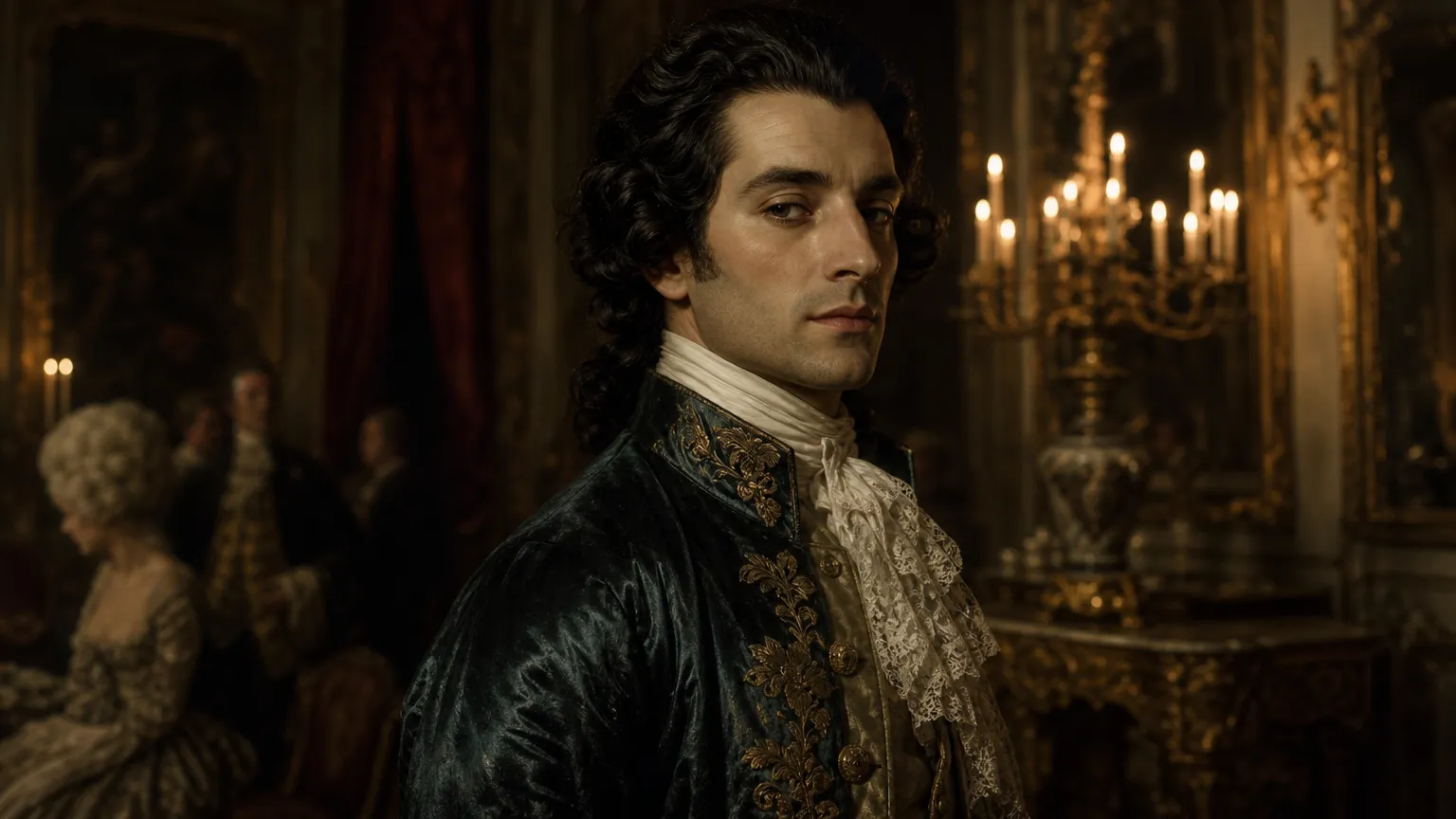
At some point in the 1740s, an elegant man of indeterminate age began to appear at the courts of Europe. He spoke French without an accent, and English, German, Italian, Portuguese, Spanish, Russian and several other languages with native fluency. He was a masterful violinist. He painted. He knew chemistry and produced dyes in colors that no artist of the time could replicate.
And he told first-person stories about events from one hundred, two hundred, three hundred years earlier.
Madame de Pompadour, the favorite of King Louis XV, heard the count describe King Francis I, who died in 1547, as if he had known him; the scene was recorded in the memoirs of her lady's maid. When asked directly about his age, the count would smile and change the subject.
His name (or the name he used) was the Count of Saint-Germain. For nearly fifty years, he appeared and vanished from European courts, diplomatic negotiations and alchemical laboratories without anyone being able to establish for certain who he was, where he came from or, in the end, what became of him.
What the documents record
The Count of Saint-Germain is not a legendary figure: he is a historical one, documented in reliable primary sources.
Madame du Hausset, lady's maid to Madame de Pompadour, left detailed memoirs, including conversations with the count at the court of Versailles around 1757. The British writer Horace Walpole mentioned him in a letter from 1745. King Frederick II of Prussia wrote about him. Voltaire called him "a man who never dies and knows everything." Prince Charles of Hesse-Kassel, with whom the count spent his last known years, left extensive memoirs.
What these documents establish: the count was real, he frequented the most important European courts of the 18th century, he was widely considered extraordinarily cultured and talented, and his origin and identity were genuinely unknown to his contemporaries.
What they do not establish: that he was centuries old, that he was immortal, or any of the more extraordinary claims attributed to him, whether by himself or by others.
The theories about who he was
In the absence of documents establishing his origin, several hypotheses have been proposed over the centuries. None has been definitively confirmed. The parallel with Nicolas Flamel is unavoidable: a man of modest origins who amassed inexplicable wealth, claimed alchemical knowledge of longevity and left a documentary trail that confirms his existence, but not the essentials.
Illegitimate son of European nobility: The hypothesis most widely accepted among historians. The count could have been the unacknowledged son of a European king or prince, which would explain his extraordinary education, his seemingly limitless resources, his access to the courts and his need to keep his identity secret. Proposed candidates include Prince Francis II Rákóczi of Transylvania and a wealthy Spanish Jewish merchant.
Secret agent: The count turned up systematically at moments of European political crisis and often mediated delicate diplomatic negotiations. Some historians propose that he was a sophisticated intelligence agent in the service of one or more European powers, which would explain his resources, his connections and his need for an obscure identity.
Alchemist with real secrets: The count displayed chemical knowledge that was genuinely advanced for the time, producing dyes, synthetic gemstones and medicinal compounds that others could not replicate. If he had alchemical or chemical knowledge that actually worked, it would have been of immeasurable value at the European courts and would explain the welcome he received.

The death that may not have happened
The Count of Saint-Germain was declared dead in February 1784 in Eckernförde, Denmark, where he had spent his last known years as the guest of Prince Charles of Hesse-Kassel.
Prince Charles recorded the death in his memoirs. A death record exists in the town of Eckernförde.
And then the count kept being seen.
In 1785, a year after his official death, he supposedly appeared at a Rosicrucian convention in Wilhelmsbad, Germany, according to the account of the Freemason Cagliostro (himself a highly controversial figure). In 1789, Marie Antoinette allegedly received a letter signed by him, warning her of the dangers of the French Revolution. In 1821, the Countess d'Adhémar claimed to have met him in Paris and described a man who looked exactly as he had forty years earlier.
These posthumous reports are less well documented than the earlier ones and rely on memoirs published decades after the events. They may be fabrications, confusions or cases of mistaken identity. But for centuries they fed the idea that the death of 1784 was part of the very performance the count had staged throughout his whole life.
What he said about himself
The count rarely made direct claims about his immortality, and that matters. In this respect he differed from Cagliostro, his contemporary (the two met in person), who was explicit in his claims of supernatural powers and miraculous cures. What the count did was not deny, smile mysteriously and let others draw their own conclusions.
When he described historical events in the first person, he may have been using a deliberate narrative technique, a way of showing detailed historical knowledge without explicitly claiming to have lived through it. But the effect on his listeners was invariably the same: the impression that they were talking to someone who had been there.
What he claimed more clearly: that he possessed elixirs of longevity he could prepare for others. That he knew the secrets of the philosopher's stone. That he had access to alchemical and spiritual knowledge beyond the conventional science of his time.
If these claims were a deliberate hoax (an elaborate performance that earned him access to European courts and the protection of the powerful), then the count was one of the greatest actors in history. If there was any real substance behind them, that substance went to the grave with him.
A legacy impossible to verify
The Count of Saint-Germain left a documentary trail rich enough for historians to study him as a real figure, and full enough of gaps for him to remain a mystery.
What is certain: he existed, he was extraordinarily cultured, he had genuine chemical and artistic skills, he frequented the most important courts in Europe, and his true origin was never definitively established.
What is uncertain: everything else. His age. Where he came from. What happened after 1784. Whether the stories of posthumous sightings have any factual basis.
Figures like the Count of Saint-Germain are fascinating not in spite of the gaps, but because of them. What we do not know about him is the most interesting half of the story, and that is exactly where each era projects what it wants to find: the spy, the alchemist, the brilliant impostor, the immortal.
The truth, if it exists anywhere, may lie in a European archive that has yet to be cataloged. Or it may have gone to the bottom of the sea with Prince Charles's papers.
The Count of Saint-Germain is not the only historical figure whose identity remains an enigma. Read also about Kaspar Hauser, the boy from nowhere, about Nicolas Flamel, the medieval alchemist whose tomb was found empty, and about the Man in the Iron Mask. For a place whose builders are as mysterious as the count, see Göbekli Tepe.