D.B. Cooper: the only unsolved hijacking in American history and the hijacker who vanished into thin air
He boarded as Dan Cooper, said he had a bomb, collected the ransom, and jumped into the darkness over Washington State. No one saw him land.
- When
- November 24, 1971
- Where
- Southwestern Washington State, United States
- Status
- Open no accepted explanation yet
By The Echoes of the Past team. Published November 2, 2026. 5 min read.

On the afternoon of November 24, 1971, a man bought a plane ticket from Portland to Seattle under the name "Dan Cooper." He boarded Northwest Orient Airlines Flight 305, took seat 18C, ordered a bourbon and soda, and handed the flight attendant a note.
The note said he had a bomb.
What happened over the next few hours became the only unsolved case of air piracy in American history and one of the most fascinating crime stories of the 20th century.
Forty-five years of FBI investigation. No definitive suspect. No body. And $5,800 in ransom bills, found on a riverbank in 1980, that raised more questions than they answered.
What happened
The passenger, described by the flight attendants as an ordinary-looking man between 40 and 50, wearing a dark suit, a black tie, and dark glasses, demanded $200,000 in used $20 bills, four parachutes, and refueling of the plane in Seattle.
The demands were met. The passengers were released in Seattle. The plane took off again with Cooper, four crew members, the parachutes, and the money.
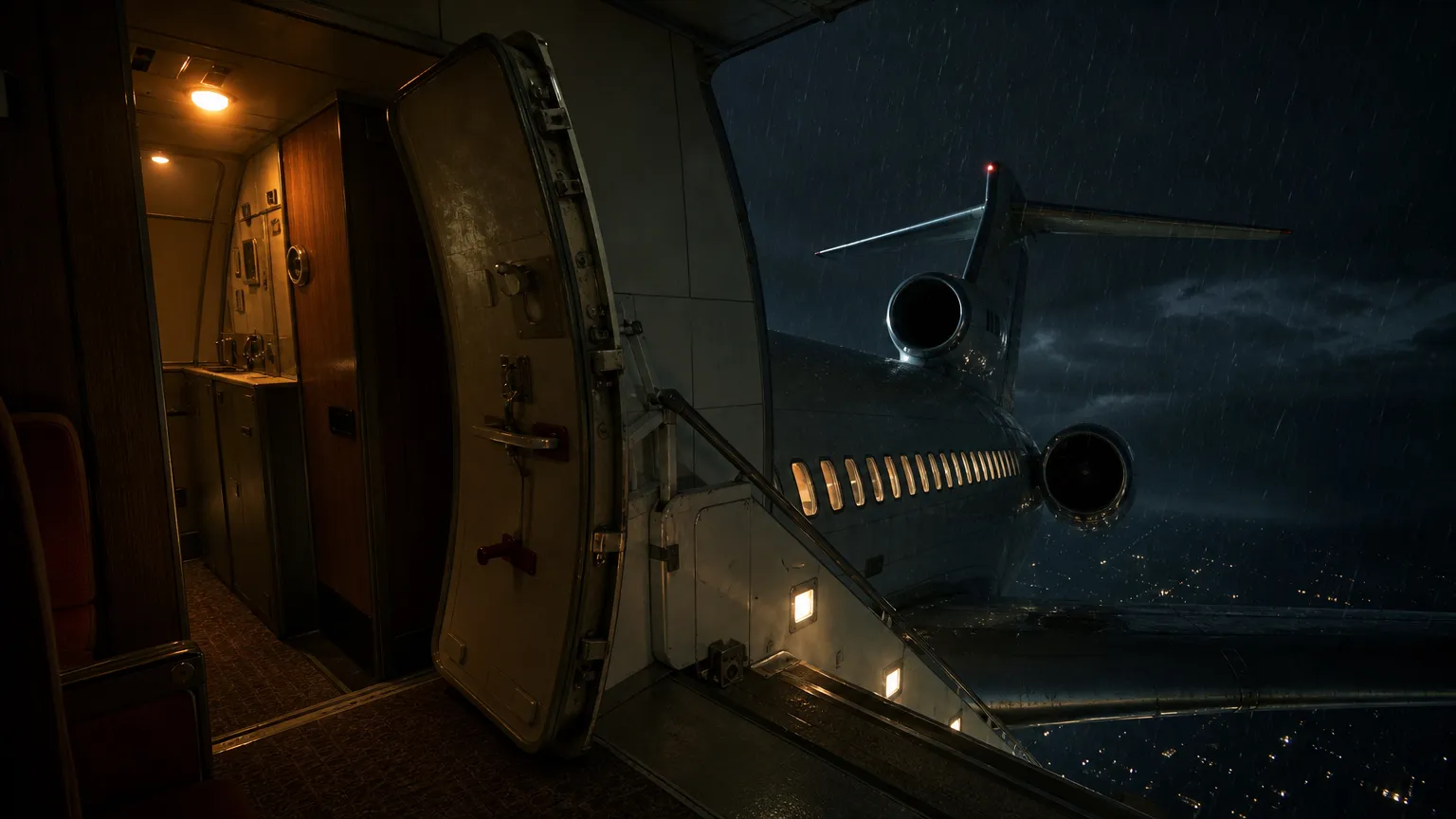
At some point between 8:00 and 8:15 p.m., Cooper lowered the rear stairs of the Boeing 727 while the plane was flying at about 3,000 meters over southwestern Washington State, in the dead of night and in heavy rain, and jumped.
No one saw him land. No one found him in the forest below. There was no trace.
What the FBI found, and what it did not
The investigation that followed was one of the most extensive in FBI history. More than 800 suspects were seriously investigated over the decades. None was definitively identified as Cooper.
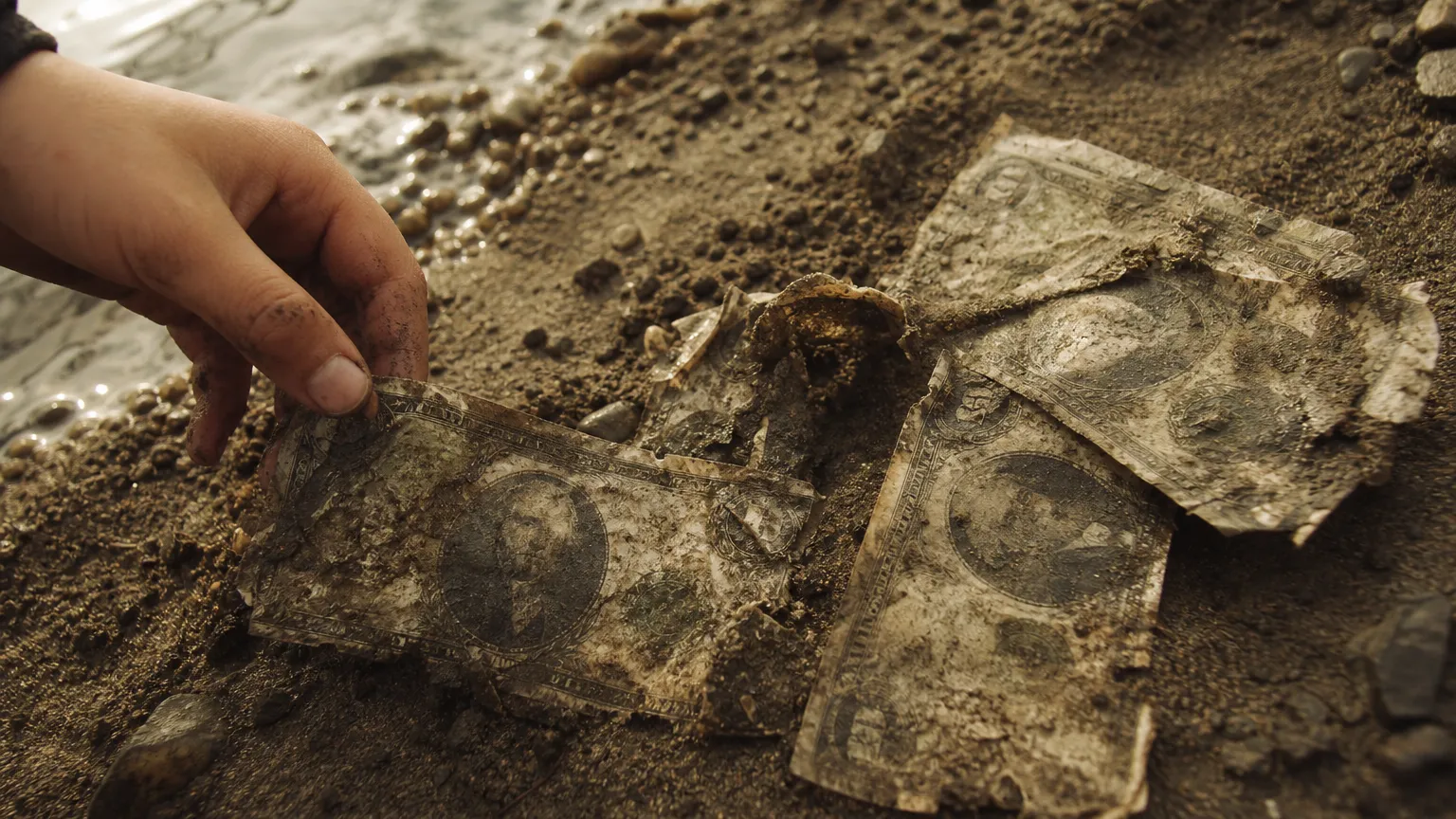
In 1980, an eight-year-old boy named Brian Ingram found $5,800 in partially decomposed $20 bills on a beach along the Columbia River, near Portland. Analysis confirmed that the bills were part of Cooper's ransom: the serial numbers matched.
This created a geographic problem: the bills were found downstream from where the FBI calculated Cooper had jumped, but the way they were scattered suggested they had been in running water for some time. What this says about Cooper's fate is ambiguous: it could mean that he survived and discarded part of the money, that he died and the money drifted away, or that the money fell into the water regardless of what happened to him.
The FBI formally ended its active investigation in 2016, after 45 years, not because the case had been solved, but because the resources no longer justified keeping it open.
The suspects and the theories
Over the decades, several candidates have been put forward by private investigators, journalists, and relatives of suspects.
Robert Rackstraw: a former paratrooper and convicted criminal, he was investigated by the FBI several times. A team of private investigators, using computer analysis of coded messages they claimed to have deciphered in Cooper's notes, said in 2016 that they had identified him. The FBI reviewed the claims and did not consider them conclusive.
L.D. Cooper: named by his niece, Marla Cooper, as the hijacker. According to her, her uncle came home bloodied and agitated the day after the hijacking. The FBI collected the suspect's DNA and compared it with material found on the tie Cooper left on the plane. The result was inconclusive.
William Gossett: a former soldier with parachuting experience, put forward by his son as the culprit. The FBI investigated and found no conclusive evidence.
The list goes on. What none of the candidates has produced is indisputable physical proof of identity: a DNA match with material from the plane, or the location of the rest of the money.
The question of survival
Most of the parachuting experts consulted by the FBI over the years consider it unlikely, but not impossible, that Cooper survived the jump. It is the same fundamental uncertainty that marks the story of the Isdal Woman, another case in which the line between suicide, accident, and murder remains blurred decades later.
The factors against survival: pitch-dark night, heavy rain, near-freezing temperatures, dense forest, rough terrain, and possibly inadequate equipment (one of the four parachutes was a nonfunctional training chute). Even an experienced skydiver would have faced enormous difficulties.
The factors in favor: the Boeing 727, with its rear stairs, was the only commercial model from which it was possible to jump in flight. Cooper knew that, which suggests technical knowledge. He asked for four parachutes but jumped with one, which some interpret as a sign that he wanted several options so he could choose the best equipment available.
The forest below the flight path was searched extensively by ground and air teams in the days that followed. Nothing was found. No body. No parachute. No equipment. Apart from the $5,800, not a cent of the remaining $194,200 of the ransom has been found since 1980.
D.B. Cooper may have died in the forest and been swallowed up by the wilderness. He may have survived and lived anonymously until a natural death: just as Kaspar Hauser appeared out of nowhere, Cooper may have vanished into nowhere. He may be dead and buried somewhere no search ever reached.
The forest of the American Northwest gave no answer. And it probably never will.
For other cases in which the identity of a key figure remains unknown, read about the Man in the Iron Mask and the Isdal Woman. For an even more mysterious disappearance, one involving an entire airplane, see Flight MH370.