The Plague of Athens: the disease that destroyed the greatest Greek empire and that no one has yet identified with certainty
Thucydides survived the disease and recorded every symptom. Doctors have studied his account for centuries, and a 2006 DNA study has not ended the debate.
- When
- 430–428 BC
- Where
- Athens, Greece
- Status
- Under debate competing explanations, no consensus
By The Echoes of the Past team. Published November 2, 2026. 5 min read.

In 430 BC, Athens was at the height of its power. It was the center of a maritime league that controlled the Aegean. It had the most powerful fleet in the Mediterranean world. It had Pericles. It had the Parthenon under construction. It had the most sophisticated democracy the world had ever seen.
Then the disease arrived.
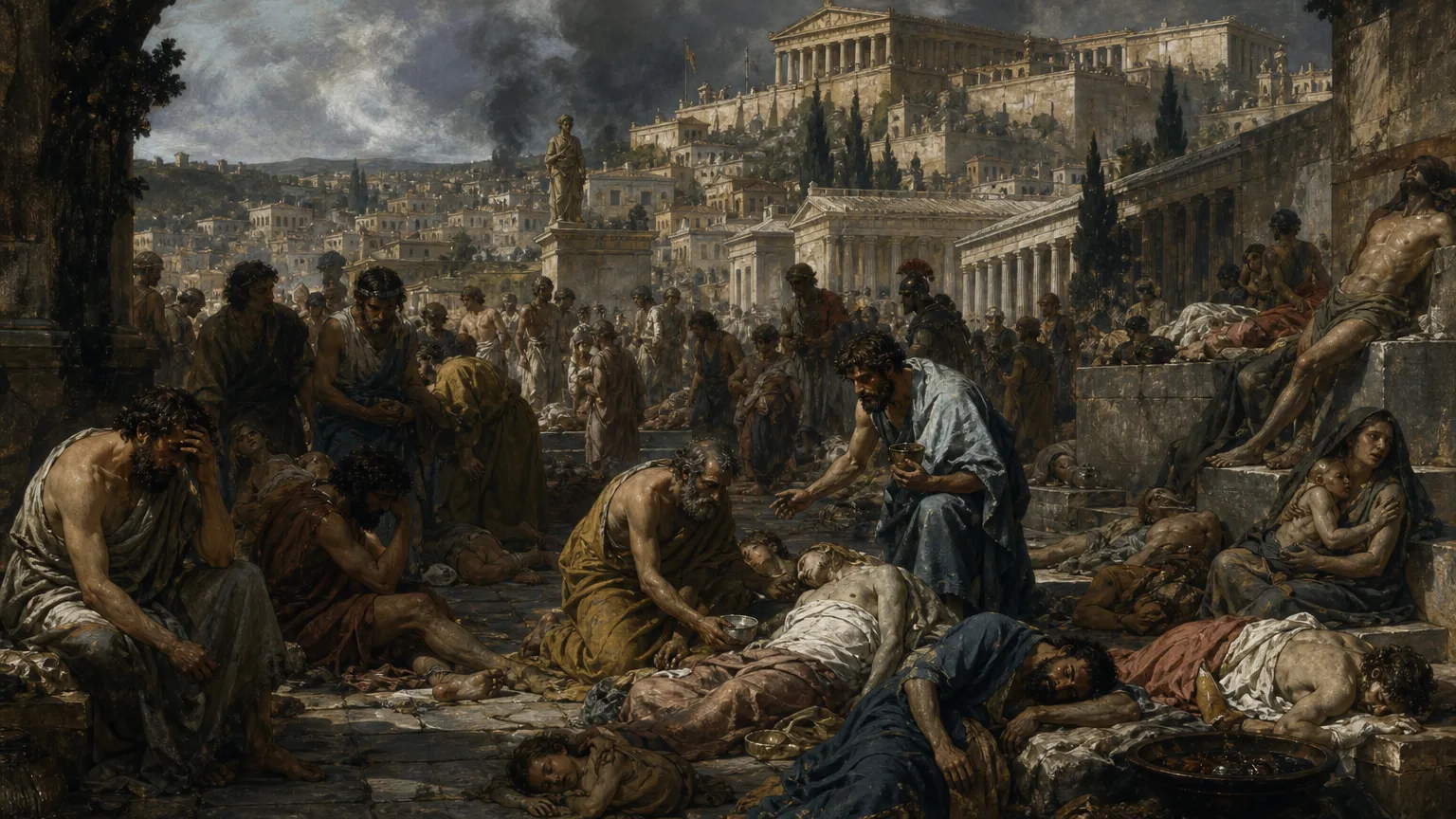
In two years, between 430 and 428 BC, it killed roughly a third of the population of Athens, including Pericles, the political architect of Athenian democracy. It also killed a quarter of the Athenian army. It destroyed Athens' ability to keep fighting the Peloponnesian War from a position of strength. It paved the way for the Athenian defeat in 404 BC and for the end of what historians call the Golden Age of Greece. The speed of the collapse recalls what happened on Easter Island: a civilization in apparent balance that, within a few decades, lost most of its population and its knowledge.
Thucydides, the greatest historian of antiquity, survived the disease and described it with extraordinary clinical precision, in more detail than any medical description of the time.
Modern physicians have read that description. And they still argue about what it was.
Thucydides' description
Thucydides described the disease through the eyes of an observer who had survived it, and with a method that anticipated modern clinical observation by centuries.
The symptoms he recorded, in sequence:
Intense heat in the head. Redness and inflammation of the eyes. Inflammation of the throat and tongue, which became "bloody and foul-smelling." Sneezing. Hoarseness. The disease then descended to the chest, causing a violent cough. When it reached the stomach, it brought on "every kind of discharge of bile." Most patients had reddened skin, with rashes and small ulcers. The body felt very hot inside, but patients could not bear heavy coverings. Many preferred to throw themselves into wells of cold water.
Thucydides also recorded the final symptoms in those who survived: gangrene of the extremities (fingers, genitals), which turned black and died. Memory loss in some survivors. Blindness in others.
Mortality among those who caught the disease was high. And it struck without regard to social standing, which for Thucydides was part of its horror: there was no way to protect yourself by being rich or powerful.
Modern diagnostic theories
Thucydides' description has been analyzed by physicians, epidemiologists and historians of medicine for centuries. The theories proposed over that time include:
Typhus: caused by the bacterium Rickettsia prowazekii, typhus causes high fever, skin rash and gastrointestinal complications. Consistent with several of the symptoms described.
Epidemic typhoid fever: unlike classic typhus, it causes similar symptoms with the addition of respiratory problems. Proposed as a theory by several physicians who have analyzed the text.
Smallpox: the "rashes and ulcers" described by Thucydides are consistent with manifestations of smallpox. The high mortality and the spread would be consistent with smallpox being introduced into a population that had never been exposed to it.
Ebola or another viral hemorrhagic fever: the speed of progression, the high mortality and some of the hemorrhagic manifestations led researchers to propose hemorrhagic viruses. The theory is problematic given the geography and the period.
A vanished disease: the most intriguing theory, and the one some epidemiologists take most seriously: Thucydides' disease may be one that no longer exists, or that has evolved into something we don't recognize in the description.
Diseases change. Pathogens evolve. The specific combination of symptoms Thucydides described may correspond to a variant or strain that has disappeared from the medical record.
The mass grave that provided evidence
In 1994–1995, during construction of a metro line in Athens, archaeologists found a 5th-century BC mass grave with more than 150 bodies, buried hastily, without the normal funeral rites of the time. The context and dating strongly suggested that the grave held victims of the Plague of Athens.
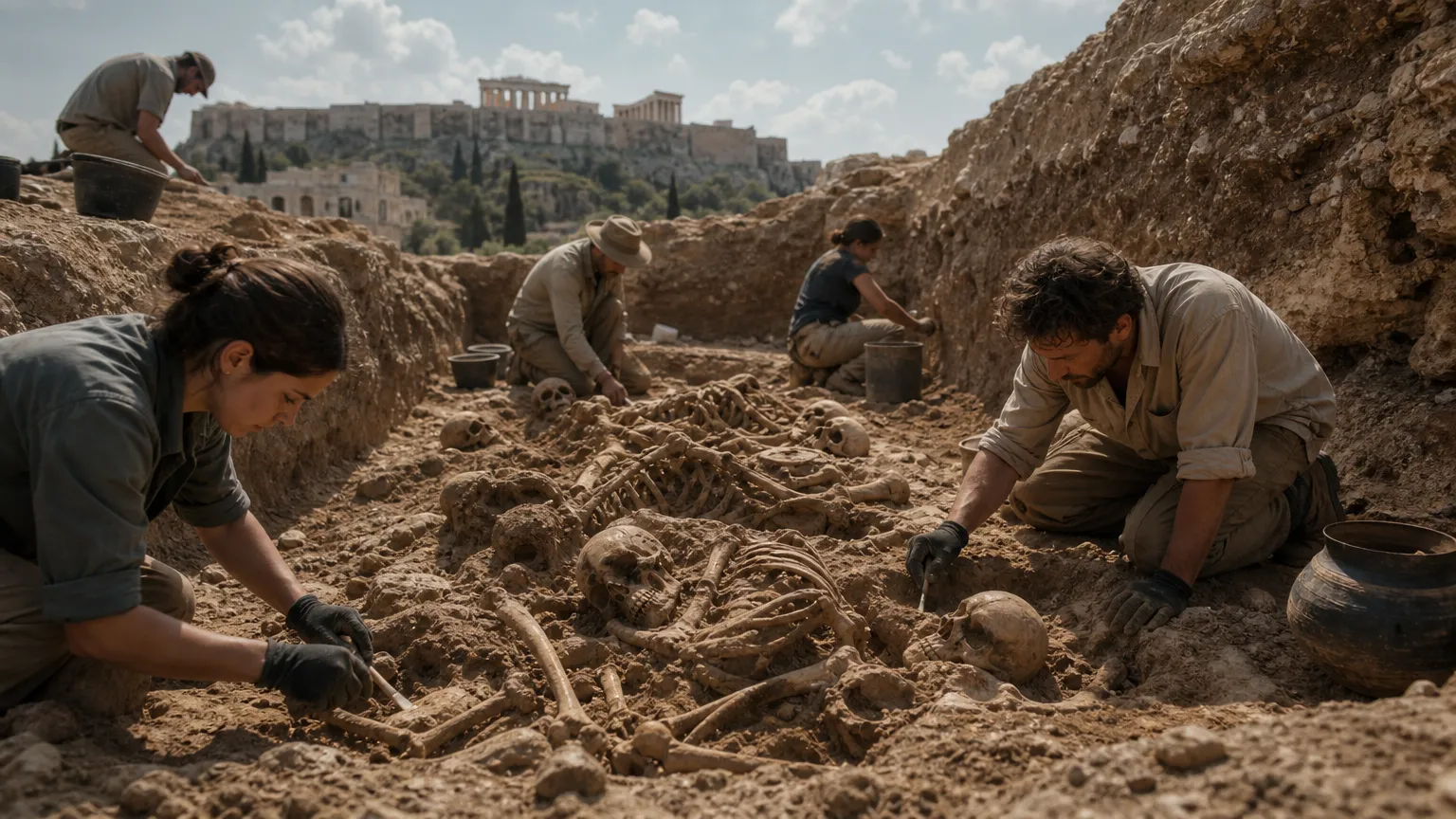
Researchers extracted dental material from three teeth from skeletons in the grave and submitted it to DNA analysis. A study published in 2006 in the International Journal of Infectious Diseases claimed to have identified DNA of Salmonella enterica serovar Typhi, the agent of typhoid fever, in the samples.
The finding was announced as potentially conclusive. The scientific community's response was cautious: contamination of ancient archaeological samples is a serious methodological problem, and identifying specific bacterial DNA in 2,400-year-old bones is technically difficult and open to question.
Typhoid fever remains a plausible but unconfirmed theory.
What the Plague of Athens destroyed besides lives
Thucydides also recorded the social collapse the disease caused, and that record may be his most lasting legacy for understanding pandemics.
When death came regardless of virtue, wealth or caution, law and social morality lost their power to compel. Thucydides describes it coldly: people disposed of the dead without ceremony, even their own relatives. Laws were ignored because anyone who broke them would probably die before being punished. Immediate pleasure became the only rational goal in a city where tomorrow was uncertain.
That analysis, written in 430 BC, reads like a manual on how epidemics destroy social structures before they destroy bodies. It was reread with unsettling recognition in 2020.
The Plague of Athens has no definitive name. But what it caused keeps repeating itself, in terms of human effect if not in terms of a specific pathogen. The Fermi paradox uses exactly this kind of civilizational collapse as a hypothesis for the Great Filter: perhaps every intelligent civilization eventually meets its own Plague of Athens.
For other events in which disease changed the course of history in unexpected ways, read about the Dancing Plague of 1518, another collective phenomenon that medicine has not fully explained. For civilizations that collapsed in different ways, see Easter Island. For the broader cosmic context of how civilizations end, see the Fermi paradox.