Fermi's great silence: if the universe has billions of stars, where is everybody?
The galaxy holds hundreds of billions of stars, many of them billions of years older than the Sun. And yet the sky remains silent.
- When
- 1950
- Where
- Los Alamos, New Mexico, United States
- Status
- Under debate competing explanations, no consensus
By The Echoes of the Past team. Published November 2, 2026. 6 min read.

In 1950, the physicist Enrico Fermi was having lunch with colleagues at Los Alamos National Laboratory when the conversation drifted to reports of flying saucers and the possibility of extraterrestrial life. Fermi went quiet for a moment, then asked:
"Where is everybody?"

The question seemed simple. The problem is that the more you examine it, the more unsettling it becomes, and decades of astronomy, biology and physics have made it sharper, not duller.
The Fermi Paradox is not a historical event like the others we cover on Echoes of the Past. It is an absence. A silence. And it may be the deepest mystery the human species has ever faced.
The numbers that make the silence so baffling
The Milky Way has roughly 400 billion stars. Current astronomical estimates suggest that most of them have planets. A significant fraction of those planets lie in the "habitable zone," the distance from a star at which liquid water can exist on the surface.
The universe is 13.8 billion years old. Earth is 4.5 billion. That means there were already stars with potentially habitable planets 9 billion years before Earth even formed.
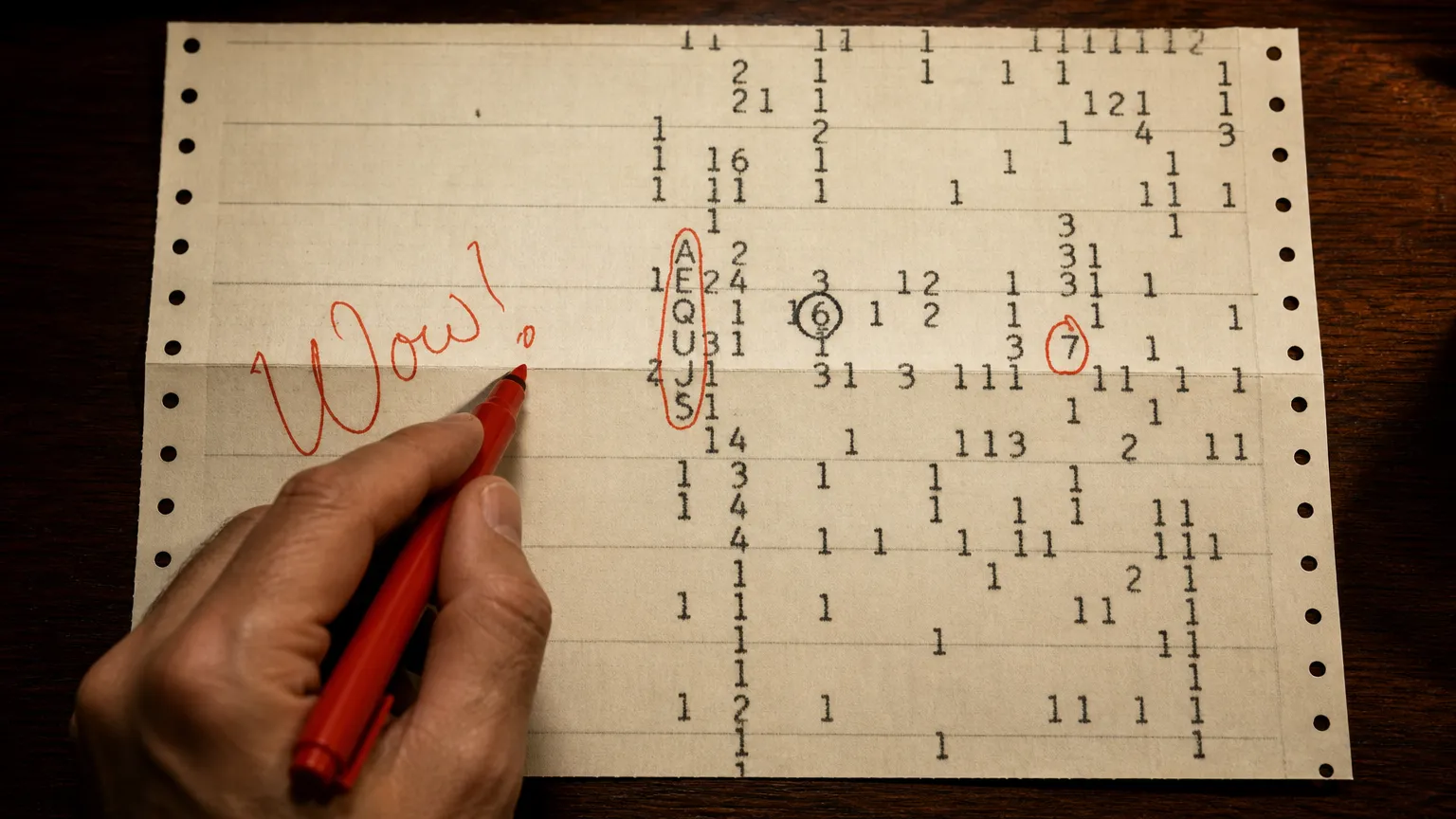
If life arises wherever conditions allow (and our only sample, Earth, suggests it arises fairly quickly when conditions are right), then the universe should be teeming with life. The Wow! signal of 1977 remains the only piece of data that could be read as evidence of this: 72 seconds of a radio signal at the hydrogen frequency, coming from a point in the constellation Sagittarius, never repeated.
And if even a tiny fraction of that life reached the technological stage we have reached, and if any one of those civilizations had another billion years to develop, it should have colonized the entire galaxy long before we came along.
Even traveling at 1% of the speed of light (technology that physics does not rule out), a civilization would need less than 10 million years to colonize every star in the Milky Way. Ten million years is a tiny fraction of the 13.8 billion years the universe has existed.
So: where are they?
The answers that never quite satisfy
Since Fermi asked the question, dozens of hypotheses have been proposed. None is entirely satisfying.
"They're too far away": Interstellar distances are immense. The nearest star is 4.2 light-years away, and a trip there would take decades even with very advanced technology. But that does not explain the silence on the radio, since radio signals travel at the speed of light. A civilization that has been transmitting for 10,000 years has already filled a sphere 10,000 light-years in radius with its emissions. We still haven't detected anything.
"We're looking the wrong way": Maybe advanced civilizations don't use radio, but some communication technology we don't know yet. That's possible. But it seems unlikely that no civilization, at any stage of development, uses radio in a detectable way.
"Intelligent life is extremely rare": Maybe the emergence of complex life, or intelligent life, or technological life is so unlikely that we really are the only civilization in the galaxy right now. The numbers of the universe make this hard to accept, but our sample size is, quite literally, one. We don't know how likely life is to arise because we only have one example.
"Civilizations destroy themselves": Most civilizations may not survive the stage of development that would make them detectable, wiping themselves out through nuclear war, climate collapse, poorly controlled genetic engineering or any of the other ways civilizations can fail. The fact that we're still here may be the exception, not the rule.
"They're watching, not talking": A sufficiently advanced civilization might have reasons to observe young civilizations without revealing itself, the way we observe animals without interfering. The problem with this hypothesis is that it requires every civilization to make the same choice, an unlikely assumption on a galactic scale.

The Great Filter
The most unsettling hypothesis is the Great Filter, proposed by the economist Robin Hanson in 1998.
If the universe should be full of civilizations and isn't, then something (some process or event) keeps civilizations from developing to the point of colonizing the galaxy. That process is the Great Filter.
The devastating question: is the filter in our past or in our future?
If the filter is in the past (if what is immensely improbable is the emergence of complex life, or of cells with a nucleus, or of sexual reproduction, or of intelligence), then we have already made it through. We are the survivors of an extraordinarily unlikely process. The future may be wide open.
If the filter is in the future (if what keeps civilizations from colonizing galaxies is something that happens after the technological stage we have reached), then every civilization that gets to where we are eventually succumbs to the same process. And we still don't know what it is.
The discovery of simple life on Mars or elsewhere in the solar system, which many astrobiologists consider possible, would be, in terms of the Fermi Paradox, disturbing news. Because it would mean that life arises commonly and that, therefore, the filter is not at the origin of life. It lies somewhere between simple life and galactic civilization. Perhaps in the Tunguska event multiplied a millionfold. Perhaps in the Battle of Los Angeles of 1942, which shows how civilizations react to the unknown with violence before understanding.
Somewhere between us and the stars.
Silence as data
The Fermi Paradox is, in a way, the mirror image of the other subjects we explore on Echoes of the Past.
In our other articles, we investigate anomalies: things that exist and shouldn't, or that existed in ways we can't explain. Here we investigate an absence: something that should exist and that we haven't found.
The silence of the universe may mean we are alone. It may mean that everyone else came before us and left. It may mean that something stopped them from going on.
The Wow! signal (72 seconds of a radio signal, in 1977, that no natural explanation fully accounts for) is the only piece of data that could be read as an answer to Fermi's question. It is not enough to claim anything. But it is enough to keep the question alive.
"Where is everybody?"
The most honest answer science has today: we don't know. And that non-answer is as unsettling now as it was for Fermi in 1950, at a lunch in Los Alamos, with the atomic bomb tested only a few years earlier and the world just emerging from the greatest war in human history.
We asked the universe. The universe has not answered yet.
The Fermi Paradox ties directly to the Wow! signal, the only serious candidate for a detected answer. For a look at how civilizations collapse here on Earth, read about Easter Island and the Plague of Athens. For the event that most clearly shows our vulnerability to impacts from space, see the Tunguska event. And for the oldest civilization we know of, which raises questions about what was lost before us, see Göbekli Tepe.