The Tunguska event: the largest explosion in modern history left no crater
In 1908, a blast a thousand times stronger than Hiroshima leveled the Siberian taiga. It left no crater and no fragments.
- When
- June 30, 1908
- Where
- Tunguska, Siberia, Russia
- Status
- Partly explained the main explanation is accepted; details remain open
By The Echoes of the Past team. Published November 2, 2026. 5 min read.
On the morning of June 30, 1908, at 7:17 a.m., something exploded over the Tunguska region of central Siberia.
The blast was picked up by seismographs across Europe and Asia. The atmospheric pressure wave circled the globe twice and was recorded by barometers all over Europe. For several nights afterward, the sky over Western Europe glowed so brightly that Londoners could read newspapers outdoors at midnight.
Estimates of the explosion's power: between 10 and 15 megatons of TNT. Roughly 1,000 times more powerful than the Hiroshima bomb. Events on this scale even come up in the debate over the Fermi paradox: cosmic impacts on inhabited planets are one of the hypotheses for the Great Filter that keeps civilizations from surviving.
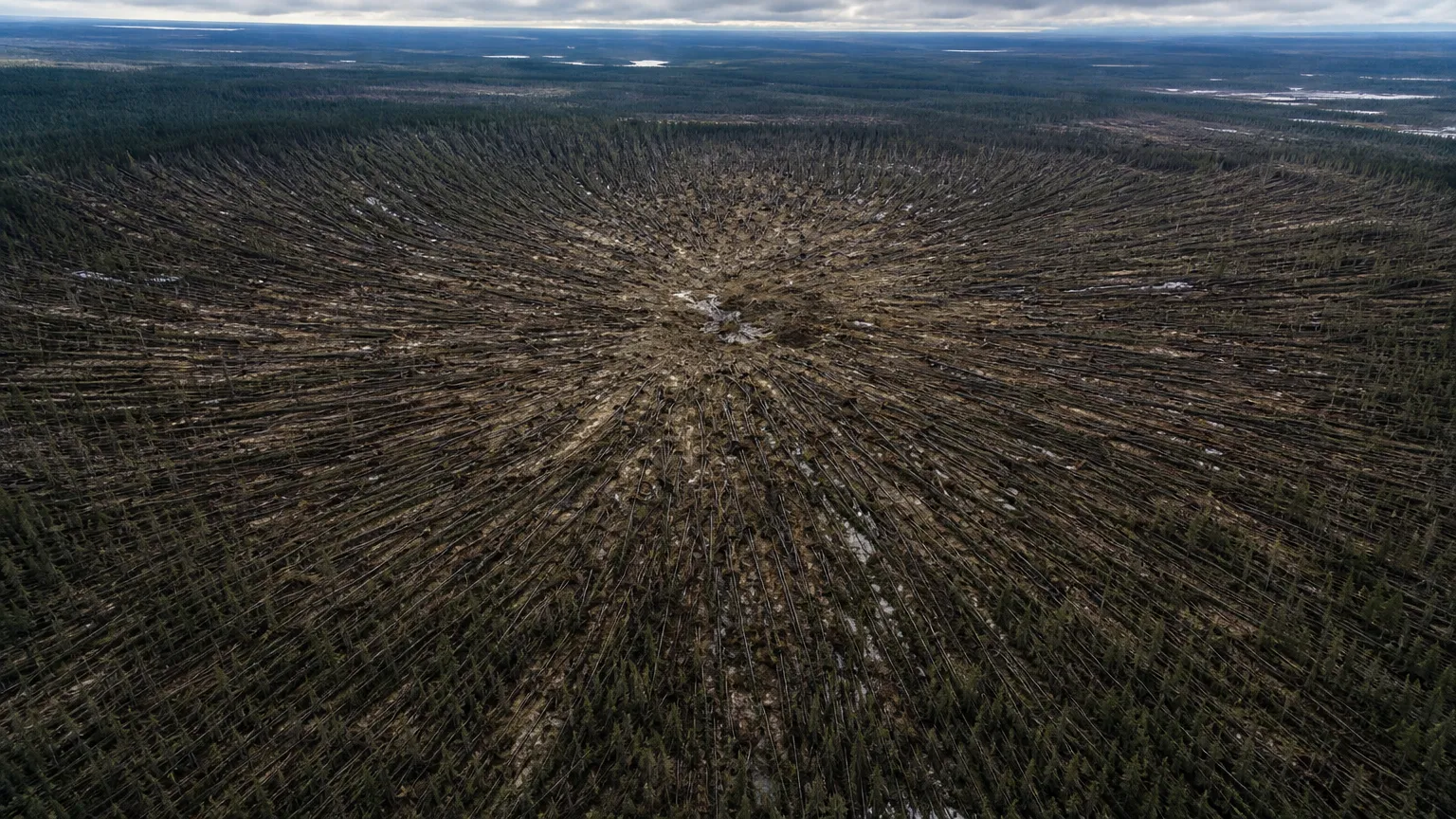
The affected area: about 2,150 square kilometers of Siberian forest. An estimated 80 million trees knocked down in a radial pattern from a central point.
And no crater. No fragments. No extraterrestrial metal. Nothing to show what had come down through the atmosphere.
Why it took 19 years for anyone to investigate
Siberia in 1908 was everything the name still evokes: remote, vast, inaccessible. The site of the event lay hundreds of kilometers from any significant settlement.
The accounts that reached Russian authorities came from traders and Evenki nomads, who described a fireball followed by an explosion that had knocked them off their feet, burned tents, and killed reindeer. Scientific stations noted the seismic effects, but the exact location was unknown.
Over the next two decades, Russia had other things on its hands: World War I, the Revolution of 1917, the Civil War. Tunguska was put on hold.
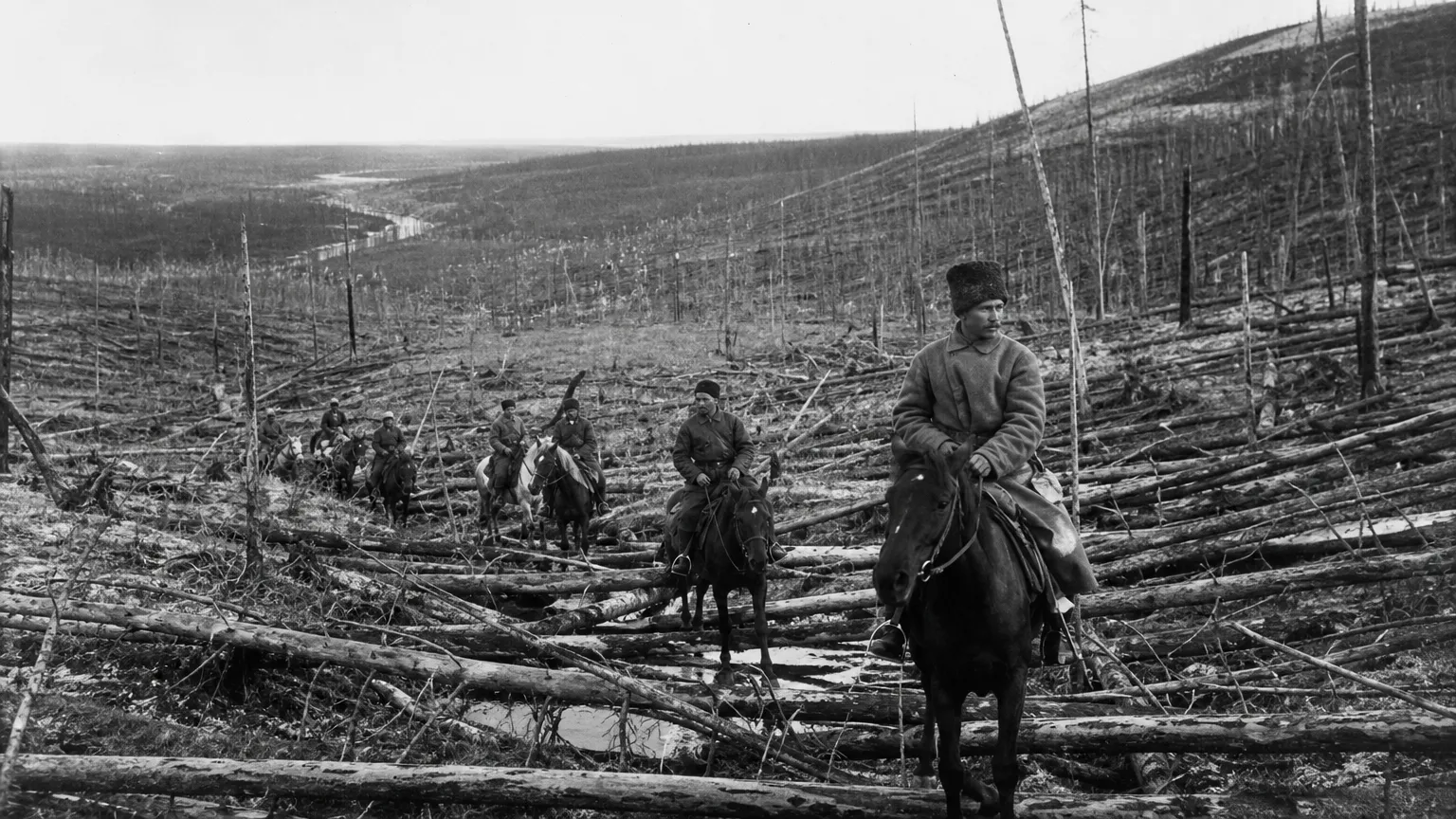
It was not until 1927 that the mineralogist Leonid Kulik led the first scientific expedition to the site. What he found must have been unsettling even for a seasoned scientist: hundreds of square kilometers of flattened forest, in a pattern that clearly pointed to a point of origin in the air, not on the ground.
There was no crater. The ground beneath the epicenter was relatively intact. The trees at the epicenter itself were still standing, stripped of their branches like a forest of telephone poles, while the trees around them had been blown outward, like the spokes of a wheel.
What science has established
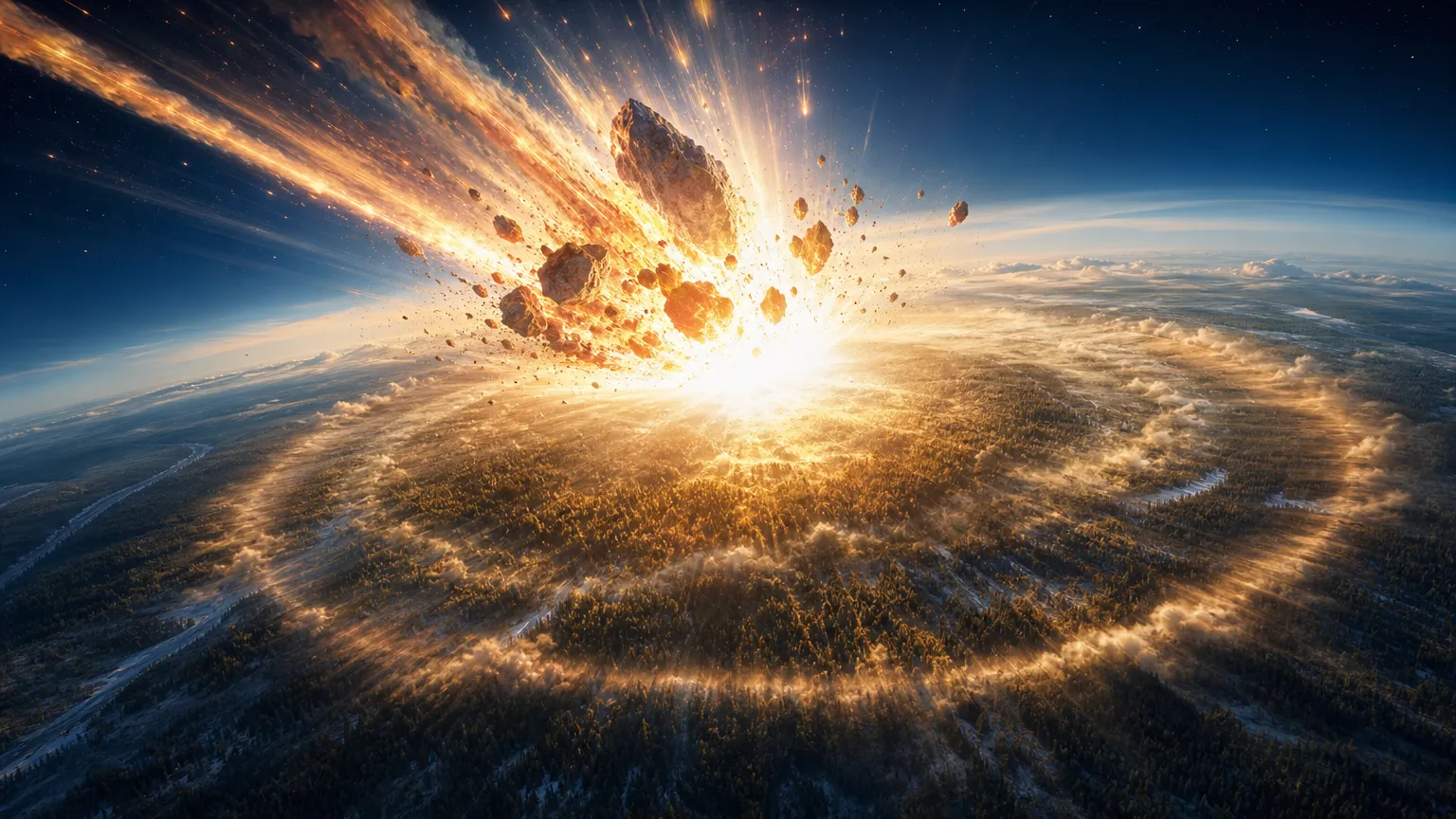
The prevailing hypothesis today, backed by decades of research and computer modeling, is that the Tunguska event was caused by the airburst of a cosmic object, most likely a rocky asteroid 50 to 80 meters across, that entered Earth's atmosphere and disintegrated at an altitude of roughly 8 to 10 kilometers.
That high-altitude disintegration explains the missing crater: the object never reached the ground. The explosion happened in the air, and the shock wave that hit the ground is what flattened the trees. Physicists call this an "airburst."
Modern models indicate that objects of this size strike Earth about once every few hundred years, and that most of them fall into the ocean or over uninhabited regions, which explains why documented events are so rare. Tunguska stood out for its combination of size and location over land.
Later expeditions found microscopic particles in the area with a chemical makeup consistent with meteoritic material, and analysis of peat preserved at the site showed geochemical anomalies consistent with extraterrestrial material deposited in 1908.
What is still not fully resolved
The asteroid airburst explanation is widely accepted. But some details are still debated among specialists.
The object's composition: A rocky asteroid or a comet? Comets have a different makeup (more ice) and would disintegrate more completely, leaving less identifiable material behind. The absence of significant fragments is consistent with both hypotheses.
The particles that were found: Studies from 2013 and 2019 of sediments in Lake Cheko (a few kilometers from the epicenter) found particles that some researchers interpret as fragments of the original object. Others dispute the connection.
Lake Cheko itself: Some studies suggested that Lake Cheko might be an impact crater left by a fragment of the object. Analysis of the lake sediment, however, indicated that the lake is at least 280 years old, which means it predates the 1908 event. The crater-lake hypothesis has been largely dismissed, though not with complete consensus.
Why Tunguska matters beyond the event itself
The Tunguska event matters not only as a historical phenomenon but as a warning about Earth's vulnerability to cosmic impacts.
In 2013, an asteroid about 20 meters across entered the atmosphere over Chelyabinsk, Russia, and exploded in an airburst, injuring more than 1,500 people with glass from windows shattered by the shock wave. Smaller than Tunguska, but enough to cause chaos in an urban area.
A Tunguska-sized event over a city of one million people would cause catastrophic destruction. Over São Paulo, New York, or Tokyo, the consequences would be historic in scale, comparable, in terms of impact on civilization, to those of the Plague of Athens, which devastated the leading Greek power of its day.
The probability of a Tunguska-sized event over a populated area in the next hundred years is low, but it is not zero. And unlike many of the mysteries we explore at Echoes of the Past, this one has practical implications for the present: it is why space agencies around the world track near-Earth objects with growing sophistication.
For other events where the sky took center stage, read about the Wow! signal and the 1942 Battle of Los Angeles. For Siberia as the setting of another mystery, see the Dyatlov Pass incident. And to understand why events like Tunguska matter for the future of human civilization, see the Fermi paradox.