Easter Island: the moai, the collapse of a civilization and the script no one has deciphered
The most famous version says Rapa Nui destroyed itself. Recent archaeology tells another story, and the island still holds a script that no one can read.
- When
- 1722–1862
- Where
- Easter Island (Rapa Nui), Chile
- Status
- Partly explained the main explanation is accepted; details remain open
By The Echoes of the Past team. Published November 2, 2026. 6 min read.
There is a version of Easter Island's history that almost everyone knows: a civilization destroyed itself by cutting down all its trees to move giant statues, collapsed into war and cannibalism, and when Europeans arrived in 1722, they found nothing but ruins and wretched survivors.
It is a powerful story. It is cited in books on economics, ecology and resource management. It is used as a metaphor for what humanity can do to itself.
The problem is that this version is, at best, incomplete. And in important respects, probably wrong.
The real history of Easter Island is more complex, tragic in other ways, and it still holds elements that no research has managed to fully explain.
What is on the island
Easter Island (Rapa Nui, in Polynesian) is a triangle of land covering 163 square kilometers in the South Pacific, 3,700 kilometers from Chile and 2,000 kilometers from the nearest archipelago. It is one of the most isolated inhabited places on Earth.
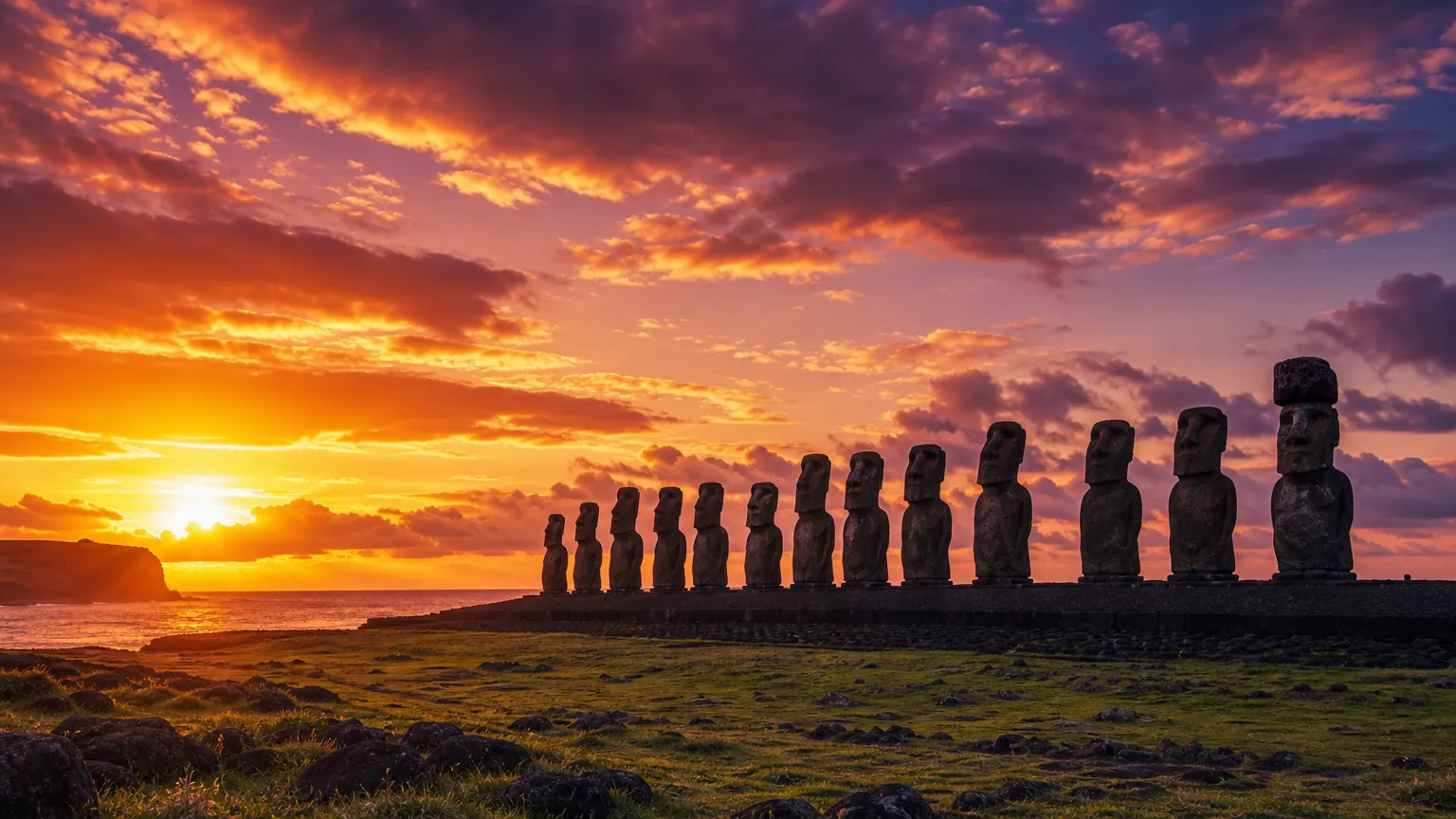
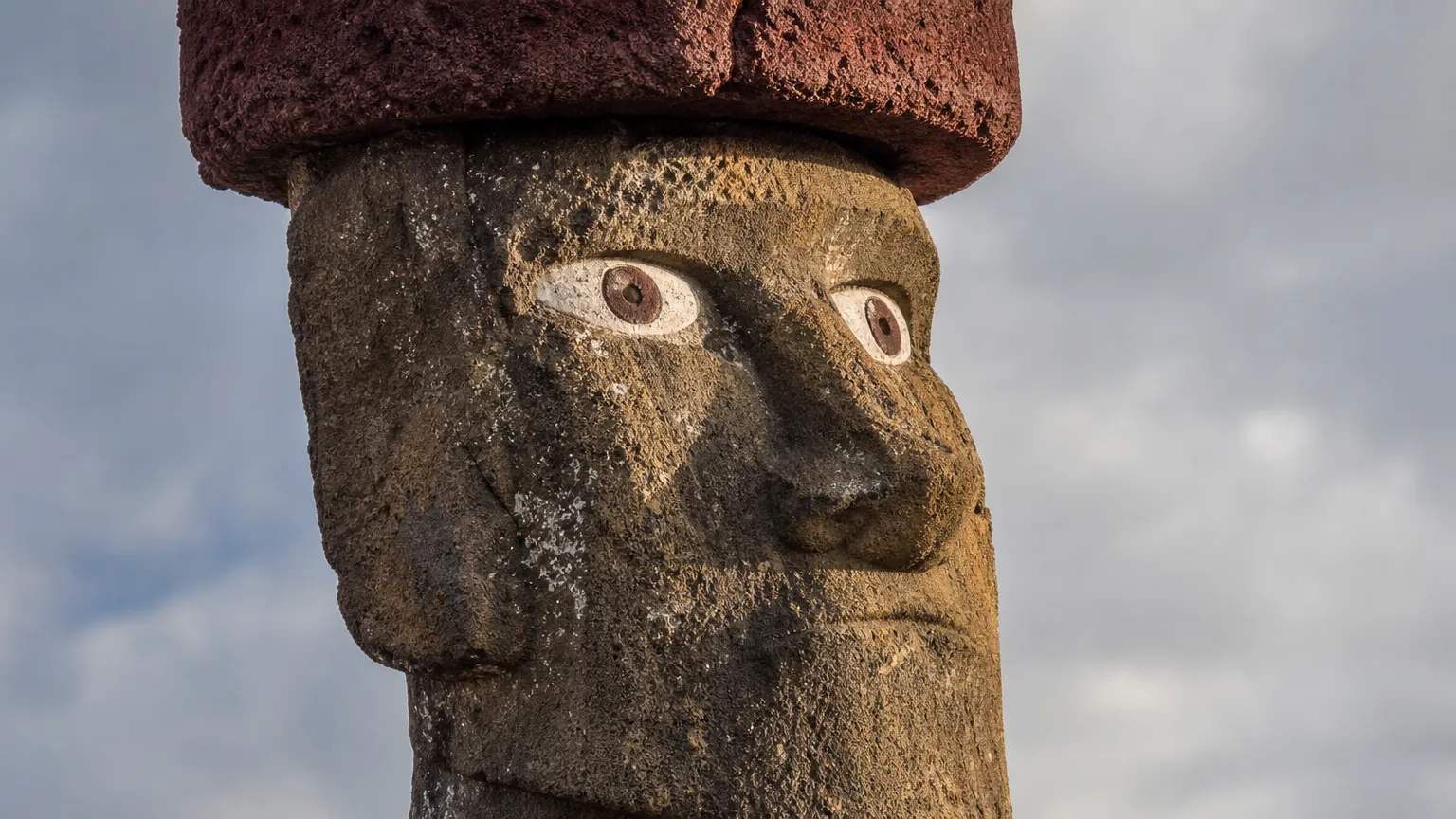
The moai are the statues that made the island famous: 900 figures carved from volcanic rock (rhyolite tuff) quarried from the Rano Raraku volcano. Most depict stylized human figures with disproportionately large heads. The average height is 4 meters, but some reach 10 meters. The largest moai ever erected weighs more than 80 tons.
About 400 moai are still at Rano Raraku, unfinished or in the middle of being moved when production stopped abruptly. That created a fascinating record of technique: you can see statues at different stages of carving, which allowed archaeologists to reconstruct the process.
How the moai were moved
For decades, transporting the moai was presented as an unsolvable mystery. The answer, revealed by modern experiments and by a detail in Rapa Nui's own oral tradition, is more elegant than anyone expected.
Oral tradition says the moai "walked." The original inhabitants told Europeans so from the very first contacts, and the claim was dismissed as myth.
In 2012, archaeologist Carl Lipo and anthropologist Terry Hunt showed, using ropes and a 5-ton moai replica, that the statue could indeed be "walked" by a team of 18 to 22 people: with ropes tied to the statue, rhythmic side-to-side rocking made it advance on its rounded base in a swaying motion. Like a refrigerator being moved upright.
The experiments reproduced transport speeds of several kilometers a day, with no need for ramps, sledges or felled trees. The rounded base of the moai, which always seemed odd for statues meant to stand upright, makes perfect sense as a design for movement.
By all indications, the oral tradition was right. The statues walked.
The collapse that may not have happened the way you learned it
The "ecocide" narrative (the Rapa Nui civilization destroying its forests to move the moai and then collapsing) was popularized by biologist Jared Diamond in his book Collapse (2005). It is compelling and well written.
More recent archaeological research has significantly complicated that narrative.
First: the island's deforestation was real, but when it happened and how it relates to the population decline are more complex than Diamond suggested. Pollen and charcoal analyses suggest the forest was reduced gradually over centuries, not destroyed all at once.
Second: the archaeological evidence of large-scale conflict before European arrival is weaker than the collapse narrative suggests. The obsidian points interpreted as spearheads, and therefore as evidence of warfare, were probably farming and hunting tools.
Third, and this is the most important point: Easter Island's greatest demographic catastrophe came after the Europeans arrived. In 1722, when the Dutchman Jacob Roggeveen landed, the island had between 3,000 and 5,000 inhabitants, relatively healthy and well fed. A century and a half later, in 1877, 111 remained.
What happened in between? Diseases brought by Europeans, to which the population had no immunity. Raids by Peruvian slavers, who carried off hundreds of people (including almost the entire elite and the keepers of traditional knowledge) to work in mines. The island was, to put it plainly, devastated by European contact.
The Rapa Nui civilization did not destroy itself. It was destroyed from outside.
Rongorongo: the script no one can read
Easter Island has another mystery, separate from the moai: Rongorongo.
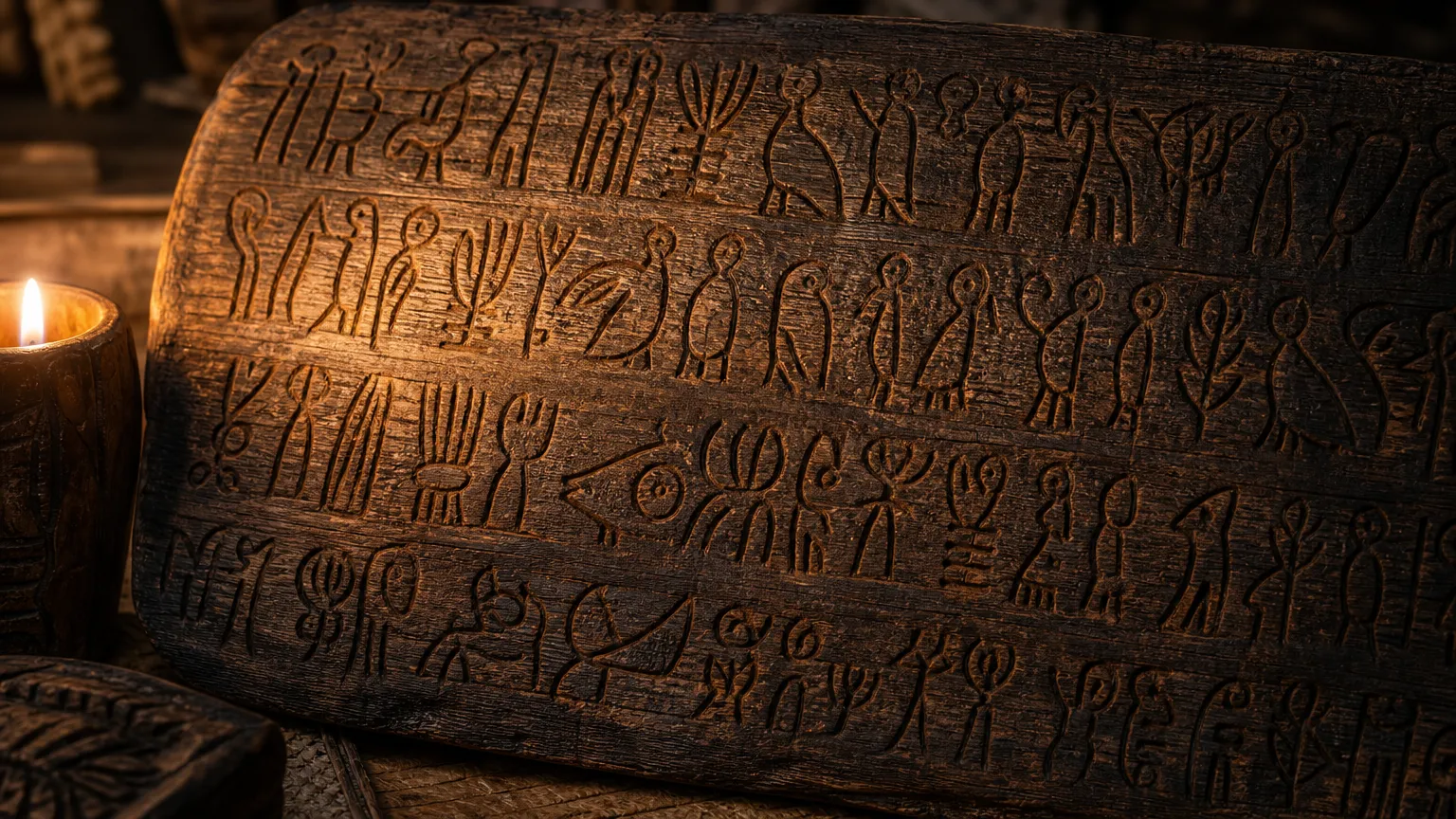
There are 26 known objects, most of them wooden tablets, a few of them staffs, covered in carved glyphs. They were collected by missionaries and researchers in the 19th century. Today they are scattered across museums around the world, from the Vatican to Russia.
Rongorongo is almost certainly a writing system, or a proto-writing system. The glyphs are standardized, consistent, clearly conventional. They depict human figures, animals, plants, astronomical objects and abstract shapes. They are read in alternating fashion, from bottom to top (one line from left to right; then the tablet is turned and the next line is read), in a system called reverse boustrophedon.
When missionaries reached the island in the 19th century and tried to find someone who could read the tablets, they discovered that the Peruvian slave raids of 1862 had carried off or killed practically every keeper of that knowledge. The few survivors who tried to "read" the tablets for the missionaries produced versions that contradicted one another, suggesting they were reciting memorized texts without necessarily reading the glyphs.
Rongorongo remains undeciphered. In terms of resisting the best efforts of cryptography and linguistics, the comparison that springs to mind is the Voynich Manuscript, another text that has crossed the centuries and defied its decipherers. There is no bilingual text to make decipherment possible (as the Rosetta Stone did for Egyptian). The glyphs are complex enough to carry textual information, but no systematic effort, including recent computer analyses, has established clear correspondences with any known language.
It may never be deciphered. The knowledge of how to read it may have died in the holds of Peruvian slave ships in 1862.
What the island keeps
Easter Island is, in a sense, an archive of losses. We lost the forests that covered it. We lost most of the people who lived there. We lost the knowledge of how to read Rongorongo. We lost the stories the moai told to those who raised them.
What remains are the stones: silent, formidable, gazing toward the island's interior (not toward the ocean, as popular myth claims), with eyes of white coral and red stone that archaeologists have reconstructed. There is something in this loss that echoes the story of Nan Madol, in Micronesia, another island civilization of the Pacific that built monuments from stones weighing dozens of tons and then vanished before explaining how.
And the question no one has managed to answer completely: what was the Rapa Nui civilization trying to say with those statues? To whom were they addressed? What did they represent?
The surviving oral tradition speaks of mana (spiritual power), which the moai concentrated and radiated over the villagers who lived behind them. But the details, the complete system of beliefs that gave the statues their meaning, were lost with the people who carried them.
The story of Easter Island is also a story about what colonization destroys. For another Pacific people whose monuments survived but whose knowledge was lost, read about Nan Madol. For another script that resists its decipherers, see the Voynich Manuscript; for a case in which DNA settled an identity but did not restore what was destroyed, see the Anastasia case. For moai of another kind, historical figures who carry immense silences, see Kaspar Hauser.